
Harpa & the Volcano Express Experience: Full Guide

Jun 30, 2026
Fred Johnson

Last updated: June 2026

Volcano Express at Harpa Concert Hall is a two-part cinematic volcano experience in central Reykjavík: a 30-minute self-guided pre-show area followed by a 10-minute ride with dynamic motion seating and real heat effects, using footage from Iceland's 2021–2024 Reykjanes Peninsula eruptions. Open daily 10:00–20:00 year-round on floor K2 of Harpa, for visitors aged 4 and up, it runs regardless of weather or activity outside. This guide covers the full experience, the building itself, and how to plan a complete waterfront visit.

Key takeaways

  • Volcano Express occupies floor K2 of Harpa Concert Hall, Austurbakki 2 — open daily 10:00–20:00, year-round and weather-independent
  • Every ticket includes both the 30-minute self-guided pre-show area and the 10-minute cinematic ride with dynamic motion seating and real heat effects
  • The Reykjanes Peninsula entered a new eruptive cycle in March 2021; multiple fissure eruptions through 2024 provide the footage inside the experience
  • Harpa Concert Hall was designed by Henning Larsen Architects, with a geometric basalt-column glass façade created by artist Ólafur Elíasson
  • The waterfront walk between Sun Voyager (Sólfar) and Harpa takes under five minutes — Reykjavík's most concentrated cultural corridor

Harpa Concert Hall: architecture, setting, and the harpa hall story

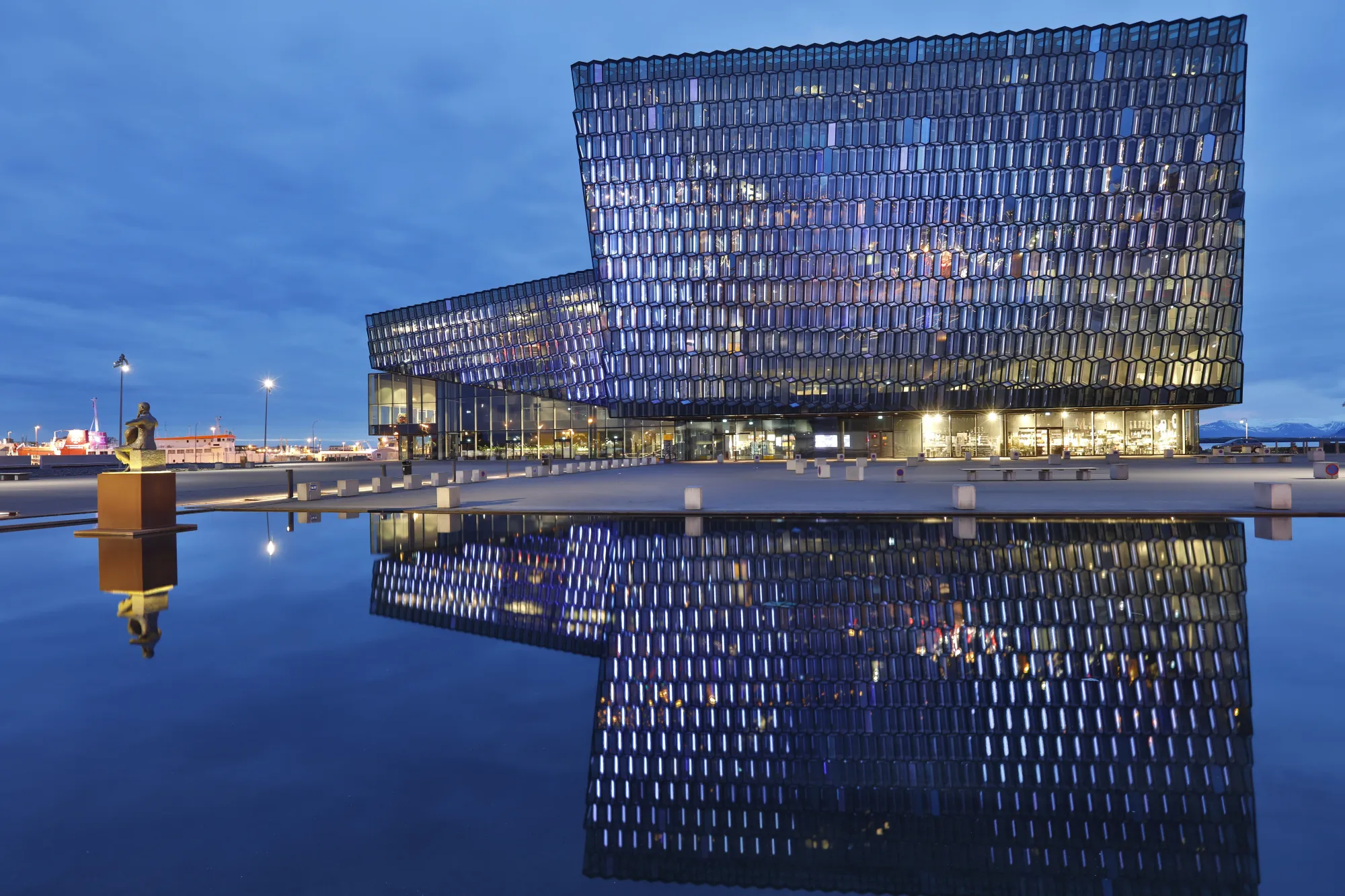
Harpa Concert Hall and Conference Centre stands at Austurbakki 2, where the city's eastern waterfront opens to the North Atlantic. The building is unmistakable — its south-facing panels shift colour with the light, cold blue before noon, amber in the long summer evenings, almost translucent in the flat grey of a January afternoon. It is not trying to blend in.

Henning Larsen Architects completed Harpa in 2011, and it received the European Union Prize for Contemporary Architecture the following year. But the building's most distinctive feature was conceived by Icelandic-Danish artist Ólafur Elíasson: the exterior façade consists of geometric honeycomb panels referencing the hexagonal basalt columns found at volcanic formations across Iceland. Walk up close and the resemblance to the cliff faces at Svartifoss or the headlands near Vík is unmistakable. Iceland's geology shaped the building as surely as it shaped the landscape surrounding it.

Inside, the scale surprises. Harpa Concert Hall serves as the resident home of the Iceland Symphony Orchestra (Sinfóníuhljómsveit Íslands) and the Icelandic Opera (Óperan), with four distinct concert halls running performances year-round. The public lobbies — fully accessible without a ticket — offer harbour-facing terraces, a ground-floor café, a bookshop, and a view of the water that reorients you toward the sea. The building is genuinely open. Visitors who arrive only for Volcano Express on floor K2 often find themselves spending considerably longer inside than they expected.

For a deeper exploration of the building's design and volcanic architectural references, Harpa Architecture: A Volcanic Masterpiece traces the connections between Elíasson's façade and Iceland's geological formations in full detail.

Harpa Concert Hall geometric basalt-column glass façade reflecting
Harpa Concert Hall geometric basalt-column glass façade

Inside the Volcano Express: the pre-show area and the journey underground

Volcano Express, inside Harpa Concert Hall on Reykjavík's waterfront, is a cinematic motion-simulator volcano experience using footage from Iceland's 2021–2024 Reykjanes Peninsula eruptions, dynamic motion seating, and real heat effects across a two-part structure: a 30-minute self-guided pre-show area followed by a 10-minute immersive ride. The experience begins not in the ride itself, but in the pre-show — a geological exhibit that builds the context the ride then makes physical.

The pre-show area covers territory that most Iceland visitors never encounter systematically. Iceland sits directly on the Mid-Atlantic Ridge, the tectonic boundary where the North American and Eurasian plates diverge at approximately 2.5 cm per year. That slow, relentless separation generates the upwelling magma that fuels Iceland's volcanic systems. The interactive eruption map in the pre-show area makes this spatial: visitors can trace the active volcanic zones of the peninsula, follow fissure lines across the map, and understand precisely why Fagradalsfjall — dormant on the Reykjanes Peninsula for roughly 800 years before March 2021 — became the most-watched eruption site in Europe when it awoke.

The live earthquake monitor is one of the experience's most striking elements. Iceland records thousands of minor seismic events every year; watching the feed during your visit turns an abstract statistic into a present-tense, live demonstration of the island's restlessness. It ticks. It logs. It does not stop.

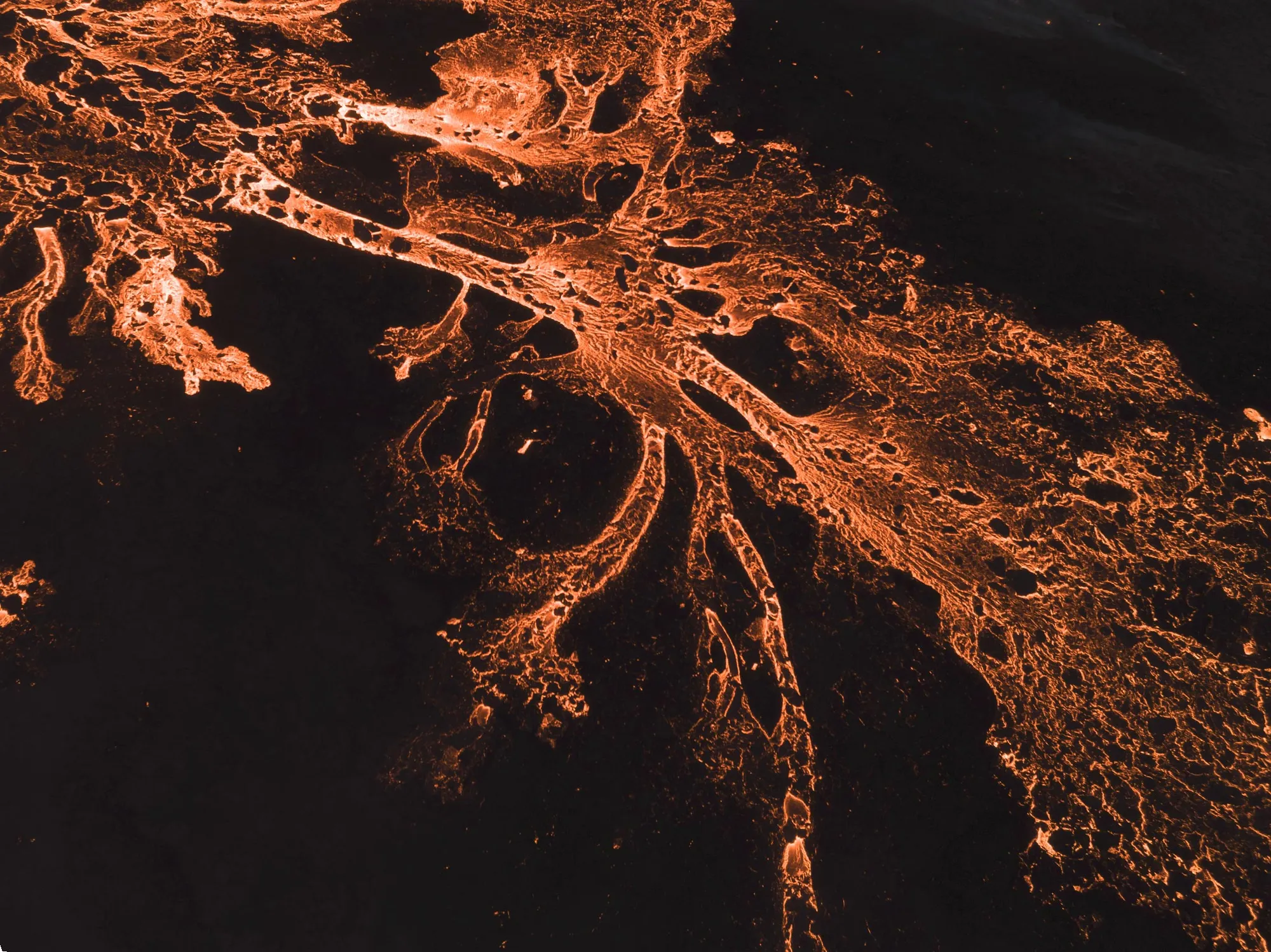
Short documentary films run in dedicated screening areas within the pre-show zone. The footage is real — the specific orange-white of fresh lava rivers against dark sky, the dense black plumes over the peninsula, the moment lava hits seawater at the coastline. No dramatisation, no reconstruction. The cameras were at Fagradalsfjall during active flow. The colours on screen are the exact colours of that event.

The Instacrater photo experience completes the self-guided pre-show area — a popular stop for visitors who want a keepsake image framed against volcanic scenery before the ride.


"Iceland's volcanic systems are among the most closely monitored on Earth — our data allows us to respond to changing conditions in near real-time." — Icelandic Meteorological Office (en.vedur.is)

What's includedWhat you get
Pre-show area30-minute self-guided exhibition: 247-eruption map, live earthquake monitor, short geology films
Instacrater photoA keepsake photo framed against volcanic scenery
Cinematic ride10-minute 4K film of Iceland's real 2021–2024 Reykjanes eruptions
Motion seatingDynamic seats that move with the on-screen eruption
Heat effectsReal radiant heat during the lava sequences
Total time15–45 minutes; shows start every 15 minutes
Suitable forAll ages (4+), weather-independent, year-round

How long does Volcano Express last?

The total Volcano Express experience lasts approximately 40 minutes: a 30-minute self-guided pre-show area included with every ticket, followed by a 10-minute cinematic ride with dynamic motion seating and real heat effects. Shows start every 15 minutes throughout the day, from 10:00 to 20:00.

Visitors control the pace of the pre-show entirely. Extra time at the interactive eruption map, a second run through a documentary film, or extended time at the live earthquake monitor all extend the visit naturally. The 10-minute cinematic ride itself runs on a fixed schedule. Most visitors budget 45–60 minutes total, including the transition from the pre-show area to the ride.

Practical timing guide:

  • Arrival: aim for 5–10 minutes before your preferred show start time
  • Pre-show area: 30 minutes, self-guided, at your own pace, included with every ticket
  • Cinematic ride: 10 minutes, motion seating, heat effects, full volcanic footage
  • Total recommended allowance: 45–60 minutes; longer if you explore every pre-show element

Shows start every 15 minutes throughout daily operating hours. The last show of the day departs at 20:00.

Is Volcano Express a roller coaster?

Volcano Express is not a roller coaster. It is an indoor cinematic motion-simulator: the seat moves in sync with eruption footage, generating the physical sensation of a volcanic environment without a physical track, drops, or inversions. The experience is suitable for families from age 4 upward.

The distinction matters. Motion sensitivity and roller coaster sensitivity are physiologically different — many visitors who avoid traditional roller coasters find motion simulators entirely manageable. The dynamic seating in Volcano Express tilts, pitches, and shudders in sync with the on-screen eruption, but the motion is controlled and calibrated for a wide age range. There are no sudden drops, no sustained darkness, and no inversions.

Floor K2 of Harpa is fully accessible by elevator from the main entrance lobby at street level. The experience is designed to accommodate visitors across a broad range of physical needs and comfort levels

Is the Volcano Express worth it?

Volcano Express is a strong match for most Reykjavík itineraries — the two-part structure delivers both geological context and direct sensory immersion, the pre-show area functions as a standalone exhibit, and year-round indoor availability makes it reliable across every season and weather condition.

In 2026, the Reykjanes Peninsula remains an active volcanic zone. The eruption cycle that began with Fagradalsfjall in March 2021 has produced lava fields that permanently altered the peninsula's southwestern coastline. The footage inside Volcano Express documents that transformation as it was happening — not archive material from decades past, but footage shot at specific fissure events that international news teams were covering as breaking geological news.

For visitors who travel to the Reykjanes Peninsula on an active access day, Volcano Express provides the context that makes the lava fields legible: the map, the timeline, the scale. For visitors whose trip does not include peninsula access — due to weather, road conditions, or itinerary — the experience delivers Iceland's volcanic story from within Reykjavík itself, with no transport required beyond a walk along the harbour.

Visitor accounts in volcano express harpa reviews consistently cite the two-part structure as one of its defining qualities. The pre-show earns the ride; the ride lands differently because of it. The sequence has a logic that a single-format experience would lack.

According to iceland.is, Iceland's volcanic landscape is consistently among the top three primary motivations for international visitors choosing Iceland over other destinations — meaning most visitors arriving in Reykjavík are already primed for a volcanic experience before they reach Harpa. Volcano Express meets that interest with footage and sensory effects that outdoor visits cannot always guarantee.

For how Volcano Express fits into a broader Reykjavík afternoon — walking distances, nearby museums, timing — Activities in Reykjavik city center covers the waterfront itinerary in full.

Is the Volcano Express footage real?

Yes — every sequence in the Volcano Express film is real, unedited footage shot at Iceland's 2021–2024 Reykjanes Peninsula eruptions, with cameras positioned at Fagradalsfjall during active flow. Iceland has been in a new eruptive phase since March 2021, but reaching an active lava field in person is unpredictable — which is exactly the gap the experience fills.

According to monitoring records from the Icelandic Meteorological Office, Iceland has produced more than a third of the world's total lava output since 1500 AD. The Reykjanes Peninsula's current eruptive cycle began at Fagradalsfjall and subsequently expanded across multiple fissure systems on the southwestern peninsula, with individual eruptions ranging from hours-long events to sustained multi-week flows across newly formed lava fields.

Active lava field access changes with short notice. Road closures and exclusion zones are managed by Icelandic Civil Protection and updated in real time at almannavarnir.is. Travellers planning outdoor visits to the peninsula's lava fields should check current access and road conditions there on the day of travel.

Volcano Express operates independently of those conditions. The experience runs year-round from floor K2 of Harpa Concert Hall — whether the Reykjanes roads are open or restricted that day has no bearing on Harpa's operating hours or the K2 experience.

Harpa Reykjavík Concert Hall: planning your visit

Harpa Concert Hall is located at Austurbakki 2, Reykjavík — a five-minute harbour walk east of the city centre — open to the public daily, with Volcano Express on floor K2 running 10:00–20:00 year-round.

Getting to Harpa

  • On foot from Lækjartorg square: 5–7 minutes east along the flat harbour promenade
  • By city bus: multiple routes serve the harbour; current schedules at visitreykjavik.is
  • By car: paid parking at Harpa's own lot on Austurbakki and in nearby city car parks on Geirsgata; Reykjavík's centre is compact and most options are a short walk from the building entrance

Inside the building

The main lobby is free to enter. Public floors include a café, a bookshop, harbour-facing terraces, and open gallery spaces. The harpa conference center reykjavik event facilities — meeting rooms and multi-use spaces across the upper floors — operate independently of the concert halls and the K2 attraction, meaning weekday conference activity rarely affects the Volcano Express visitor experience.

Volcano Express is on floor K2. From the main lobby, take the escalators or lifts down one level and follow signage. The pre-show entrance and ticket collection are visible from the escalator landing.

Practical notes:

  • Online booking at volcanoexpress.is secures a preferred show time, though walk-ups are served on availability
  • The experience is fully accessible via the lift from street level
  • Harpa's lobby cafés are a convenient option for a break before continuing along the waterfront
  • The harpa concert programme occasionally includes free lobby events — check the schedule at harpa.is on the day of your visit

Exploring the Harpa waterfront: the Old Harbour and beyond

The corridor between Sun Voyager (Sólfar) and the Old Harbour (Gamla höfnin) is Reykjavík's most walkable cultural stretch, with Harpa Concert Hall sitting at its midpoint and Volcano Express anchoring the most concentrated visitor half-day on the waterfront.

Sun Voyager (Sólfar) and the promenade

Sun Voyager (Sólfar) stands on the waterfront promenade approximately 400 metres west of Harpa. Jón Gunnar Árnason designed it as a dream boat — the stainless steel hull faces north across the bay toward Mount Esja. In the right light, particularly in the long golden evenings of June and July or against a winter clear-sky horizon, it remains one of the most photographed objects in Iceland. The walk from Sólfar to Harpa takes under five minutes along the flat harbour path.

West of Harpa, the Old Harbour (Gamla höfnin) district begins at the working harbour basin. Fish restaurants line the piers; whale watching vessels depart from the east quay throughout the season; industrial buildings now house creative studios, food stalls, and visitor services. A morning whale watching departure from the Old Harbour followed by an afternoon Volcano Express visit at Harpa covers two of the waterfront's strongest draws without requiring any transport between them.

The Settlement Exhibition (Landnámssýningin)

Three minutes south of Harpa on Aðalstræti 16, the Settlement Exhibition (Landnámssýningin) is built around a Viking longhouse excavated in situ, dated to approximately 930 AD. It puts Iceland's human story directly alongside the geological one: people arrived on an island of active volcanoes and built longhouses from the same basalt that Volcano Express documents in motion. The two experiences, taken together on a single Reykjavík afternoon, span more than a thousand years of Iceland's relationship with its volatile landscape.

For restaurant recommendations, walking routes, and a full planning guide for the neighbourhood, Old Harbour & Harpa Guide — Things to Do, Food & Volcano Express covers the district in detail.

Sun Voyager at golden hour.

When you're ready to feel it

Stand outside Harpa Concert Hall on Austurbakki for a moment before you go in. Look at the façade — the hexagonal glass panels, the shift of light across the geometric surface, the way the building appears to be made of the same material as the volcanic cliffs 45 minutes south down the peninsula. Then take the escalator to K2, find your place in the pre-show area, and let the earthquake monitor and the eruption maps do their work. The footage came from drones at active lava flows. The heat, when the ride begins, is calibrated from real thermal data. Volcano Express and Harpa Concert Hall are both, in their different ways, Iceland's geological story translated into human scale — one through architecture, one through direct sensory experience. Both are worth the time it takes to walk the harbour to Austurbakki 2 and go inside.

In this guide

Last updated: June 2026

Volcano Express at Harpa Concert Hall is a two-part cinematic volcano experience in central Reykjavík: a 30-minute self-guided pre-show area followed by a 10-minute ride with dynamic motion seating and real heat effects, using footage from Iceland's 2021–2024 Reykjanes Peninsula eruptions. Open daily 10:00–20:00 year-round on floor K2 of Harpa, for visitors aged 4 and up, it runs regardless of weather or activity outside. This guide covers the full experience, the building itself, and how to plan a complete waterfront visit.

Key takeaways

  • Volcano Express occupies floor K2 of Harpa Concert Hall, Austurbakki 2 — open daily 10:00–20:00, year-round and weather-independent
  • Every ticket includes both the 30-minute self-guided pre-show area and the 10-minute cinematic ride with dynamic motion seating and real heat effects
  • The Reykjanes Peninsula entered a new eruptive cycle in March 2021; multiple fissure eruptions through 2024 provide the footage inside the experience
  • Harpa Concert Hall was designed by Henning Larsen Architects, with a geometric basalt-column glass façade created by artist Ólafur Elíasson
  • The waterfront walk between Sun Voyager (Sólfar) and Harpa takes under five minutes — Reykjavík's most concentrated cultural corridor

Harpa Concert Hall: architecture, setting, and the harpa hall story

Harpa Concert Hall and Conference Centre stands at Austurbakki 2, where the city's eastern waterfront opens to the North Atlantic. The building is unmistakable — its south-facing panels shift colour with the light, cold blue before noon, amber in the long summer evenings, almost translucent in the flat grey of a January afternoon. It is not trying to blend in.

Henning Larsen Architects completed Harpa in 2011, and it received the European Union Prize for Contemporary Architecture the following year. But the building's most distinctive feature was conceived by Icelandic-Danish artist Ólafur Elíasson: the exterior façade consists of geometric honeycomb panels referencing the hexagonal basalt columns found at volcanic formations across Iceland. Walk up close and the resemblance to the cliff faces at Svartifoss or the headlands near Vík is unmistakable. Iceland's geology shaped the building as surely as it shaped the landscape surrounding it.

Inside, the scale surprises. Harpa Concert Hall serves as the resident home of the Iceland Symphony Orchestra (Sinfóníuhljómsveit Íslands) and the Icelandic Opera (Óperan), with four distinct concert halls running performances year-round. The public lobbies — fully accessible without a ticket — offer harbour-facing terraces, a ground-floor café, a bookshop, and a view of the water that reorients you toward the sea. The building is genuinely open. Visitors who arrive only for Volcano Express on floor K2 often find themselves spending considerably longer inside than they expected.

For a deeper exploration of the building's design and volcanic architectural references, Harpa Architecture: A Volcanic Masterpiece traces the connections between Elíasson's façade and Iceland's geological formations in full detail.

Harpa Concert Hall geometric basalt-column glass façade reflecting
Harpa Concert Hall geometric basalt-column glass façade

Inside the Volcano Express: the pre-show area and the journey underground

Volcano Express, inside Harpa Concert Hall on Reykjavík's waterfront, is a cinematic motion-simulator volcano experience using footage from Iceland's 2021–2024 Reykjanes Peninsula eruptions, dynamic motion seating, and real heat effects across a two-part structure: a 30-minute self-guided pre-show area followed by a 10-minute immersive ride. The experience begins not in the ride itself, but in the pre-show — a geological exhibit that builds the context the ride then makes physical.

The pre-show area covers territory that most Iceland visitors never encounter systematically. Iceland sits directly on the Mid-Atlantic Ridge, the tectonic boundary where the North American and Eurasian plates diverge at approximately 2.5 cm per year. That slow, relentless separation generates the upwelling magma that fuels Iceland's volcanic systems. The interactive eruption map in the pre-show area makes this spatial: visitors can trace the active volcanic zones of the peninsula, follow fissure lines across the map, and understand precisely why Fagradalsfjall — dormant on the Reykjanes Peninsula for roughly 800 years before March 2021 — became the most-watched eruption site in Europe when it awoke.

The live earthquake monitor is one of the experience's most striking elements. Iceland records thousands of minor seismic events every year; watching the feed during your visit turns an abstract statistic into a present-tense, live demonstration of the island's restlessness. It ticks. It logs. It does not stop.

Short documentary films run in dedicated screening areas within the pre-show zone. The footage is real — the specific orange-white of fresh lava rivers against dark sky, the dense black plumes over the peninsula, the moment lava hits seawater at the coastline. No dramatisation, no reconstruction. The cameras were at Fagradalsfjall during active flow. The colours on screen are the exact colours of that event.

The Instacrater photo experience completes the self-guided pre-show area — a popular stop for visitors who want a keepsake image framed against volcanic scenery before the ride.


"Iceland's volcanic systems are among the most closely monitored on Earth — our data allows us to respond to changing conditions in near real-time." — Icelandic Meteorological Office (en.vedur.is)

What's includedWhat you get
Pre-show area30-minute self-guided exhibition: 247-eruption map, live earthquake monitor, short geology films
Instacrater photoA keepsake photo framed against volcanic scenery
Cinematic ride10-minute 4K film of Iceland's real 2021–2024 Reykjanes eruptions
Motion seatingDynamic seats that move with the on-screen eruption
Heat effectsReal radiant heat during the lava sequences
Total time15–45 minutes; shows start every 15 minutes
Suitable forAll ages (4+), weather-independent, year-round

How long does Volcano Express last?

The total Volcano Express experience lasts approximately 40 minutes: a 30-minute self-guided pre-show area included with every ticket, followed by a 10-minute cinematic ride with dynamic motion seating and real heat effects. Shows start every 15 minutes throughout the day, from 10:00 to 20:00.

Visitors control the pace of the pre-show entirely. Extra time at the interactive eruption map, a second run through a documentary film, or extended time at the live earthquake monitor all extend the visit naturally. The 10-minute cinematic ride itself runs on a fixed schedule. Most visitors budget 45–60 minutes total, including the transition from the pre-show area to the ride.

Practical timing guide:

  • Arrival: aim for 5–10 minutes before your preferred show start time
  • Pre-show area: 30 minutes, self-guided, at your own pace, included with every ticket
  • Cinematic ride: 10 minutes, motion seating, heat effects, full volcanic footage
  • Total recommended allowance: 45–60 minutes; longer if you explore every pre-show element

Shows start every 15 minutes throughout daily operating hours. The last show of the day departs at 20:00.

Is Volcano Express a roller coaster?

Volcano Express is not a roller coaster. It is an indoor cinematic motion-simulator: the seat moves in sync with eruption footage, generating the physical sensation of a volcanic environment without a physical track, drops, or inversions. The experience is suitable for families from age 4 upward.

The distinction matters. Motion sensitivity and roller coaster sensitivity are physiologically different — many visitors who avoid traditional roller coasters find motion simulators entirely manageable. The dynamic seating in Volcano Express tilts, pitches, and shudders in sync with the on-screen eruption, but the motion is controlled and calibrated for a wide age range. There are no sudden drops, no sustained darkness, and no inversions.

Floor K2 of Harpa is fully accessible by elevator from the main entrance lobby at street level. The experience is designed to accommodate visitors across a broad range of physical needs and comfort levels

Is the Volcano Express worth it?

Volcano Express is a strong match for most Reykjavík itineraries — the two-part structure delivers both geological context and direct sensory immersion, the pre-show area functions as a standalone exhibit, and year-round indoor availability makes it reliable across every season and weather condition.

In 2026, the Reykjanes Peninsula remains an active volcanic zone. The eruption cycle that began with Fagradalsfjall in March 2021 has produced lava fields that permanently altered the peninsula's southwestern coastline. The footage inside Volcano Express documents that transformation as it was happening — not archive material from decades past, but footage shot at specific fissure events that international news teams were covering as breaking geological news.

For visitors who travel to the Reykjanes Peninsula on an active access day, Volcano Express provides the context that makes the lava fields legible: the map, the timeline, the scale. For visitors whose trip does not include peninsula access — due to weather, road conditions, or itinerary — the experience delivers Iceland's volcanic story from within Reykjavík itself, with no transport required beyond a walk along the harbour.

Visitor accounts in volcano express harpa reviews consistently cite the two-part structure as one of its defining qualities. The pre-show earns the ride; the ride lands differently because of it. The sequence has a logic that a single-format experience would lack.

According to iceland.is, Iceland's volcanic landscape is consistently among the top three primary motivations for international visitors choosing Iceland over other destinations — meaning most visitors arriving in Reykjavík are already primed for a volcanic experience before they reach Harpa. Volcano Express meets that interest with footage and sensory effects that outdoor visits cannot always guarantee.

For how Volcano Express fits into a broader Reykjavík afternoon — walking distances, nearby museums, timing — Activities in Reykjavik city center covers the waterfront itinerary in full.

Is the Volcano Express footage real?

Yes — every sequence in the Volcano Express film is real, unedited footage shot at Iceland's 2021–2024 Reykjanes Peninsula eruptions, with cameras positioned at Fagradalsfjall during active flow. Iceland has been in a new eruptive phase since March 2021, but reaching an active lava field in person is unpredictable — which is exactly the gap the experience fills.

According to monitoring records from the Icelandic Meteorological Office, Iceland has produced more than a third of the world's total lava output since 1500 AD. The Reykjanes Peninsula's current eruptive cycle began at Fagradalsfjall and subsequently expanded across multiple fissure systems on the southwestern peninsula, with individual eruptions ranging from hours-long events to sustained multi-week flows across newly formed lava fields.

Active lava field access changes with short notice. Road closures and exclusion zones are managed by Icelandic Civil Protection and updated in real time at almannavarnir.is. Travellers planning outdoor visits to the peninsula's lava fields should check current access and road conditions there on the day of travel.

Volcano Express operates independently of those conditions. The experience runs year-round from floor K2 of Harpa Concert Hall — whether the Reykjanes roads are open or restricted that day has no bearing on Harpa's operating hours or the K2 experience.

Harpa Reykjavík Concert Hall: planning your visit

Harpa Concert Hall is located at Austurbakki 2, Reykjavík — a five-minute harbour walk east of the city centre — open to the public daily, with Volcano Express on floor K2 running 10:00–20:00 year-round.

Getting to Harpa

  • On foot from Lækjartorg square: 5–7 minutes east along the flat harbour promenade
  • By city bus: multiple routes serve the harbour; current schedules at visitreykjavik.is
  • By car: paid parking at Harpa's own lot on Austurbakki and in nearby city car parks on Geirsgata; Reykjavík's centre is compact and most options are a short walk from the building entrance

Inside the building

The main lobby is free to enter. Public floors include a café, a bookshop, harbour-facing terraces, and open gallery spaces. The harpa conference center reykjavik event facilities — meeting rooms and multi-use spaces across the upper floors — operate independently of the concert halls and the K2 attraction, meaning weekday conference activity rarely affects the Volcano Express visitor experience.

Volcano Express is on floor K2. From the main lobby, take the escalators or lifts down one level and follow signage. The pre-show entrance and ticket collection are visible from the escalator landing.

Practical notes:

  • Online booking at volcanoexpress.is secures a preferred show time, though walk-ups are served on availability
  • The experience is fully accessible via the lift from street level
  • Harpa's lobby cafés are a convenient option for a break before continuing along the waterfront
  • The harpa concert programme occasionally includes free lobby events — check the schedule at harpa.is on the day of your visit

Exploring the Harpa waterfront: the Old Harbour and beyond

The corridor between Sun Voyager (Sólfar) and the Old Harbour (Gamla höfnin) is Reykjavík's most walkable cultural stretch, with Harpa Concert Hall sitting at its midpoint and Volcano Express anchoring the most concentrated visitor half-day on the waterfront.

Sun Voyager (Sólfar) and the promenade

Sun Voyager (Sólfar) stands on the waterfront promenade approximately 400 metres west of Harpa. Jón Gunnar Árnason designed it as a dream boat — the stainless steel hull faces north across the bay toward Mount Esja. In the right light, particularly in the long golden evenings of June and July or against a winter clear-sky horizon, it remains one of the most photographed objects in Iceland. The walk from Sólfar to Harpa takes under five minutes along the flat harbour path.

West of Harpa, the Old Harbour (Gamla höfnin) district begins at the working harbour basin. Fish restaurants line the piers; whale watching vessels depart from the east quay throughout the season; industrial buildings now house creative studios, food stalls, and visitor services. A morning whale watching departure from the Old Harbour followed by an afternoon Volcano Express visit at Harpa covers two of the waterfront's strongest draws without requiring any transport between them.

The Settlement Exhibition (Landnámssýningin)

Three minutes south of Harpa on Aðalstræti 16, the Settlement Exhibition (Landnámssýningin) is built around a Viking longhouse excavated in situ, dated to approximately 930 AD. It puts Iceland's human story directly alongside the geological one: people arrived on an island of active volcanoes and built longhouses from the same basalt that Volcano Express documents in motion. The two experiences, taken together on a single Reykjavík afternoon, span more than a thousand years of Iceland's relationship with its volatile landscape.

For restaurant recommendations, walking routes, and a full planning guide for the neighbourhood, Old Harbour & Harpa Guide — Things to Do, Food & Volcano Express covers the district in detail.

Sun Voyager at golden hour.

When you're ready to feel it

Stand outside Harpa Concert Hall on Austurbakki for a moment before you go in. Look at the façade — the hexagonal glass panels, the shift of light across the geometric surface, the way the building appears to be made of the same material as the volcanic cliffs 45 minutes south down the peninsula. Then take the escalator to K2, find your place in the pre-show area, and let the earthquake monitor and the eruption maps do their work. The footage came from drones at active lava flows. The heat, when the ride begins, is calibrated from real thermal data. Volcano Express and Harpa Concert Hall are both, in their different ways, Iceland's geological story translated into human scale — one through architecture, one through direct sensory experience. Both are worth the time it takes to walk the harbour to Austurbakki 2 and go inside.

In this guide

Share this article

Questions about

Harpa & the Volcano Express Experience: Full Guide

Is the Volcano Express worth it?
How long does Volcano Express last?
Is Volcano Express a roller coaster?
Are there any active lava flows in Iceland right now?
Is Volcano Express suitable for young children?

9 Best Restaurants Near Harpa & Old Harbor: 2026 Foodie Guide

Let’s cover some of the best restaurants near Harpa and throughout this compact capital city.

Harpa Architecture: A Volcanic Masterpiece

Harpa isn’t just another concert hall, it’s a building that captures the essence of Iceland in glass and steel.

Top Activities in Reykjavik City Center – Begin with Volcano Express

Begin your Reykjavik city center adventure with Volcano Express – an unforgettable volcano show in the heart of Harpa Concert Hall.

Old Harbour and Harpa Neighbourhood Guide: Explore Activities, Tours, Food, and Architecture in Reykjavík

Reykjavík's Old Harbour and Harpa neighbourhood form one of the city's most rewarding areas to explore — a compact stretch of waterfront where industrial heritage, world-class design, and a buzzing food scene meet.
Other articles you may like

Related Article

This is just a placeholder that gets changed by finsweets CMS slider.
A magma river