Best Photo Spots Around Harpa (Inside and Out)
If you've spent any time scrolling through travel photos of Reykjavík, you've seen Harpa. You might even have it saved to a Pinterest board. You probably also have no idea how to actually photograph it well, because most of the shots online are the same wide exterior view from across the water, and that's barely scratching the surface.
Here's what you need to know, both about the building itself and where to point your camera.
A Quick Word on the Building
Harpa opened in 2011, making it the new kid on the block by Icelandic standards. It was designed by the Danish firm Henning Larsen Architects in collaboration with the Danish-Icelandic artist Olafur Eliasson, who handled the facade. If you've seen Eliasson's work elsewhere, you know he's obsessed with light, perception, and how buildings interact with the sky. Harpa is basically that obsession turned into a concert hall.
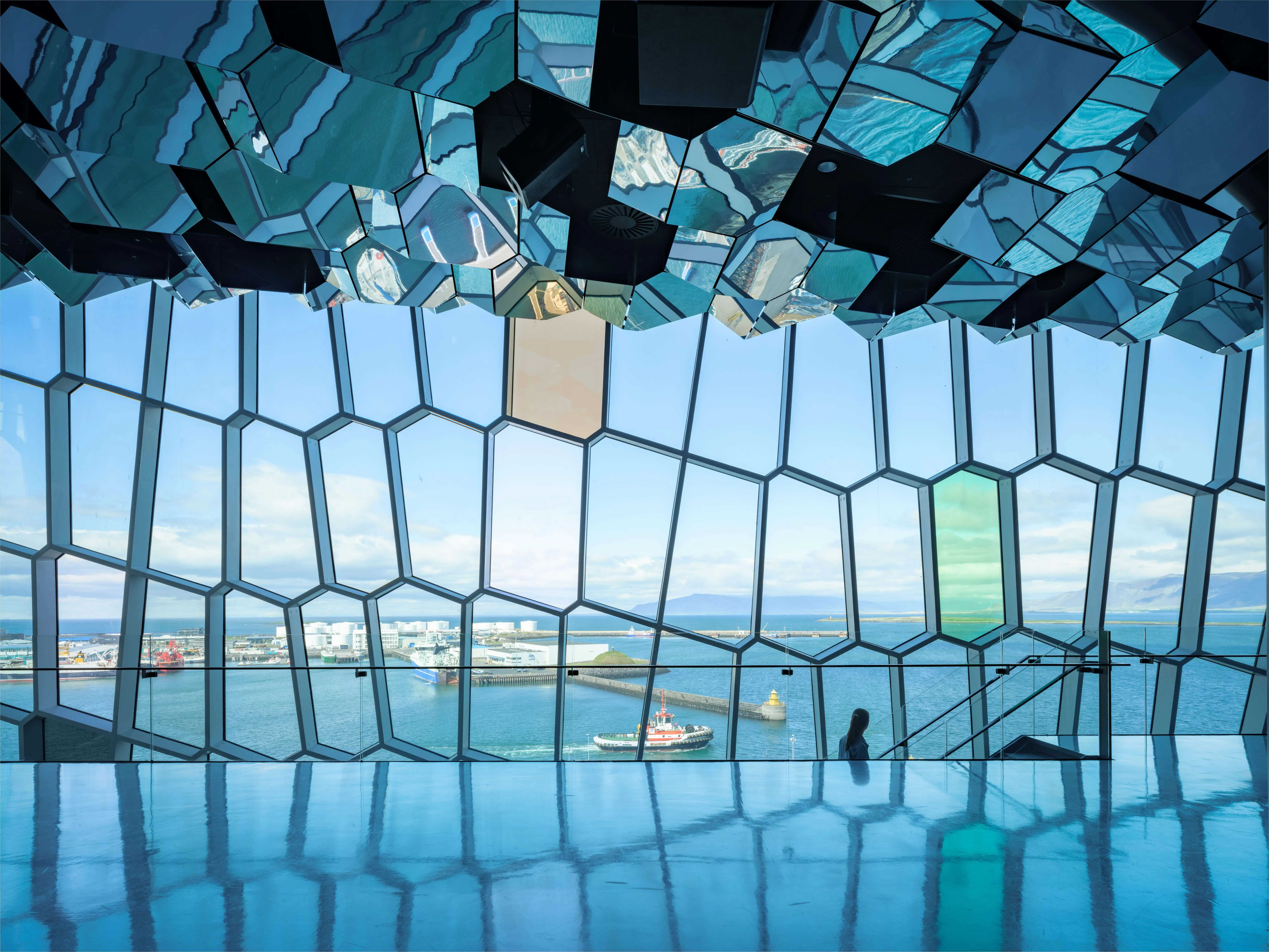
The facade is made up of 12-sided glass panels inspired by the columnar basalt formations you find all over Iceland — the same hexagonal rock columns at places like Reynisfjara and Svartifoss. Some of the panels are mirrored, some are tinted, some are clear, and the whole thing is rigged with LEDs that can light up at night. The result is a building that looks completely different depending on the time of day, the weather, and where you're standing, which is, of course, exactly the point.
Photographing Outside the Building
The Classic Harborside Wide Shot
You've seen this one — it's the wide shot from across the small inlet, where you get the full facade reflected in the water with Mount Esja in the background. The trick is to walk a bit further than most people do. Most tourists stop at the first viewpoint they hit and shoot from there. Keep going west along the water until you're past the Reykjavík Maritime Museum area, then turn around. The angle from there gives you more of the building's curve and a better foreground. Early morning and late evening are best for reflections, when the harbor water is calmest, and the low sun makes the glass panels light up.
If you're here in winter, this same spot at blue hour (the half-hour after sunset, when the sky goes that deep electric blue) is spectacular. The building lights up, and the contrast against the dark sky is the kind of thing that doesn't really need a filter.
The Up-Close Facade Detail
Walk right up to the building. Like, right up to it, your face nearly touching the glass. Then look up.
This is the shot most people miss, and it's arguably the most interesting one Harpa offers. Up close, the geometric panels create these incredible repeating patterns that go all the way up the side of the building, and depending on the angle, you can catch the sky reflected in some panels and the harbor reflected in others. Shoot vertically, get as close as you can, and let the geometry do the work.
The Stairs on the East Side
There's a set of wide concrete stairs on the eastern side of the building, near where you'd walk in from the city. People sit on them, enjoy a snack, and take phone calls. They make a really good foreground for a photo of the building because they give you a sense of scale: the building is bigger than it looks in pictures. Having a person sitting on those steps with the facade looming behind makes that obvious.
Have someone sit a few steps up, frame the shot from below so you're looking up past them at the glass, and you've got something with actual depth instead of just a building.
The Reflection in the Plaza
There's a large open plaza on the south side of Harpa that, after rain, turns into a giant mirror. You can crouch low and shoot the building reflected in the puddles, creating a perfect symmetrical composition without any actual editing. If it hasn't rained recently, this won't work. But if you've just had one of those classic Reykjavík squalls where the sky opens up for 15 minutes and then everything goes calm, run, don't walk to the plaza. You have maybe an hour before the wind dries everything out.
The View From Across the Bay
If you've got more time and a willingness to walk, head over to the Sólfar (Sun Voyager) sculpture, about 10 minutes east along the waterfront path. From there, you get a side view of Harpa with the harbor and city behind it. It's not the standard shot, which is exactly why it's worth getting. You can also frame Harpa through the Sun Voyager itself if you crouch down and angle correctly, which gives you two iconic Reykjavík landmarks in one frame.
Inside the Building
This is where most visitors drop the ball. They circle the outside, take their picture, and leave, never going in. The interior is free to enter and arguably more photogenic than the exterior.
A few things to know before you go in: Harpa is a working concert hall and conference center, so the inside isn't a museum — it's a space that's actively being used. Be respectful of events and people working. That said, the public areas (lobby, stairs, upper floors) are open for walking around, and you're absolutely allowed to take photos.
The Lobby Looking Up
The first thing to do when you walk in: stop walking, look up, and don't move. The interior of the facade is just as patterned as the exterior, but from inside, the panels filter the daylight into thousands of little geometric shapes that scatter across the floor and walls. On a sunny day, this is probably the single most photogenic moment in the entire city.
Shoot straight up. Use the wide-angle on your phone. The honeycomb pattern goes on forever, and the light effects are constantly shifting, so take more than one shot — you'll get something different every time.
The Staircase on the North Side
There's a staircase on the harbor-facing side of the building that some say is the best photo spot in Harpa, and almost no one uses it. It's a wide, gentle stair with the geometric facade running alongside it, so as you go up, you're walking past these enormous panes of patterned glass with the harbor visible through them.
Shoot it two ways: have your travel companion stand on the stairs about halfway up, and shoot from below, looking up, to capture the staircase, the person, and the facade in one frame. Then shoot the same scene from above, looking down. The geometry works both ways beautifully.
The Upper Floors
Take the elevator or the stairs to the upper floors — there are four levels you can access — and walk around the perimeter. Each floor has slightly different views, and the light coming through the glass at different heights does different things.
The Red Concert Hall Interior
The main concert hall, Eldborg, has these stunning red interior walls that look almost volcanic, which is fitting, since the name refers to a fiery volcanic crater. You usually can't get in unless you're attending a concert or taking a guided tour, but Harpa offers public tours daily for a small fee that let you go inside the main hall.
If you can swing it, do the tour. The red interior is unlike anything else in the building, and it photographs beautifully — moody, warm, and dramatic. It's a real change of pace from the cool blue-and-clear glass of the rest of the building.
The Mirror Ceiling on the South Side
On the south side of the building, on one of the ground-floor public areas, there's a section where the ceiling is mirrored. Stand underneath it, point your camera straight up, and you get a doubled, kaleidoscopic version of yourself with the geometric ceiling pattern going off in every direction.
This is the move if you want a self-portrait that doesn't look like every other tourist self-portrait. It takes some fiddling to get the framing right — you'll probably take ten before you get one you like — but it's an original shot that almost nobody gets.
A Few Practical Tips
A handful of things worth knowing before you go:
The lighting changes constantly. If you got a shot you didn't love, come back two hours later, and it'll be a different building. The same goes for weather — Harpa in fog, Harpa in snow, Harpa at golden hour, and Harpa at blue hour are essentially four different buildings.
Phones do really well here. You don't need a fancy camera to get good Harpa photos. The geometric patterns and reflective surfaces are what make the shots work, and a phone camera handles all of that fine. If anything, a phone is better for the up-close detail shots because you can get into tighter spaces.
It's busiest in the middle of the day. If you want shots without crowds, go early (it opens around 8:00 a.m.) or late (it stays open until 10:00 p.m. or later, depending on events). Early morning is especially good because the light is softer and the building is mostly empty.
The wind is real. The plaza outside Harpa is right on the harbor, and it gets the full brunt of whatever weather is coming off the Atlantic. Hold onto your hat. Hold onto your phone.
There's no entry fee. The exterior is obviously free to walk around. The interior is also free to enter and explore. Tours, concerts, and Volcano Express (the volcano-themed immersive experience inside Harpa) all cost money, but the building itself is open to anyone who wants to walk in. Take advantage of that. Most people don't.
Now go get the shot.