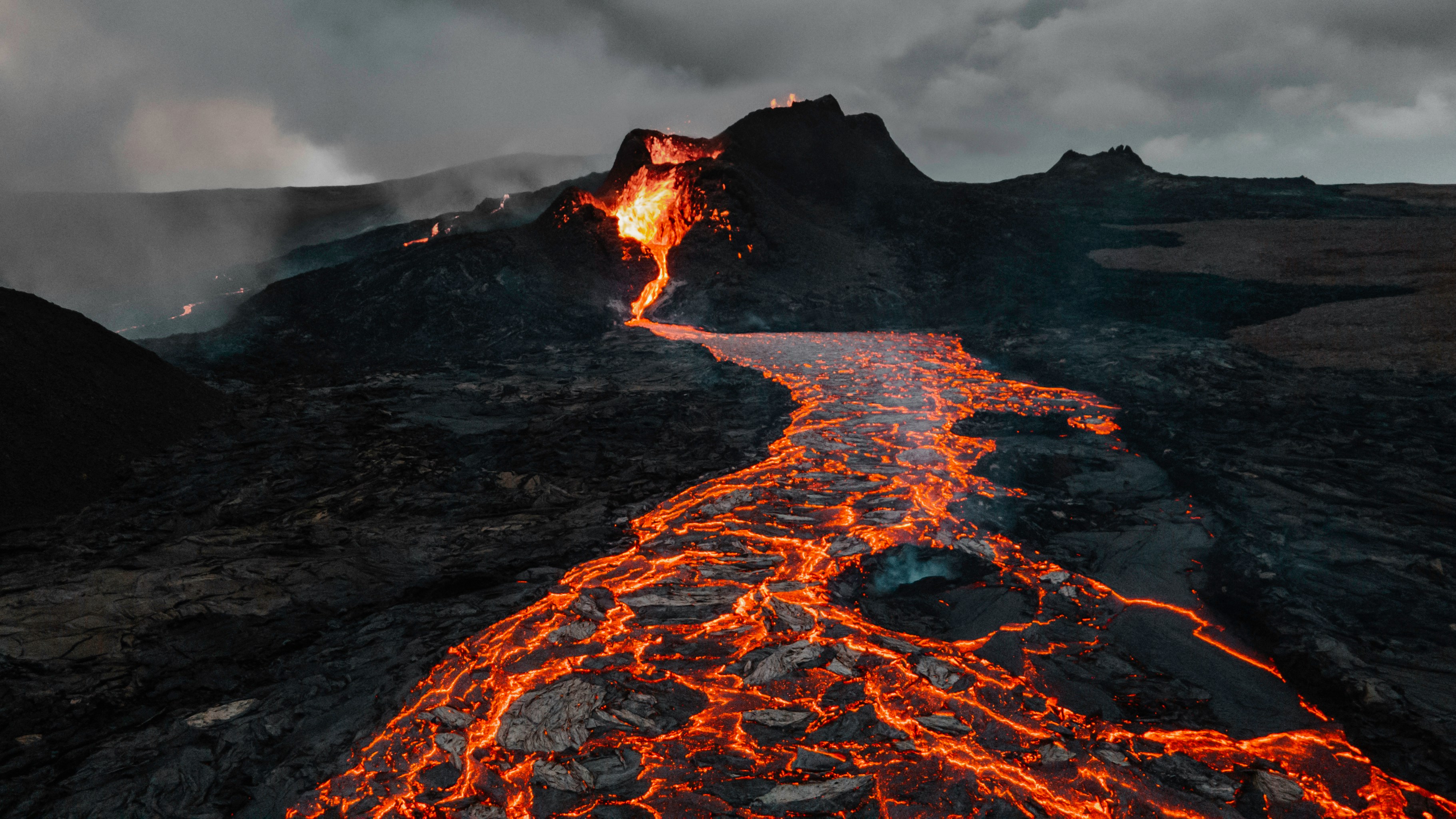
Is Fagradalsfjall Still Erupting?
Key takeaways
- Fagradalsfjall produced eruptions in March 2021, August 2022, and July 2023 — the three events that began Iceland's current eruptive cycle
- Since late 2023, the active system has been Svartsengi, not Fagradalsfjall — the two systems are distinct, though both sit on the Reykjanes Peninsula
- The Reykjanes Peninsula sits on the Mid-Atlantic Ridge, where the Eurasian and North American tectonic plates separate at approximately 2 cm per year
- Volcano Express runs year-round indoors at Harpa Concert Hall in central Reykjavík — the only weather-independent volcanic experience available regardless of peninsula access
What Is an Erupting Volcano?
An erupting volcano is a geological vent through which magma, ash, and gas escape from the Earth's interior to the surface. On the Reykjanes Peninsula, eruptions take the form of fissure events: magma rises along linear cracks in the crust rather than from a single summit crater. Lava flows outward at the surface, building new land while ash and volcanic gas rise into the air. The Icelandic Meteorological Office (Veðurstofa Íslands) classifies eruption types and monitors ground deformation, seismic activity, and gas emissions across all of Iceland's active volcanic systems — data published live at en.vedur.is.
Erupting Volcano Iceland: Which System Is Active and When?
The currently active erupting volcano iceland zone is the Svartsengi volcanic system on the Reykjanes Peninsula, where repeated fissure eruptions have occurred since December 2023 — a different system from Fagradalsfjall.
The Reykjanes eruptive cycle began with the Geldingadalir eruption in March 2021 — the first eruption on the peninsula in approximately 800 years. Two further eruptions followed in the Fagradalsfjall system in 2022 and 2023. From late 2023, activity shifted 8 kilometres west to Svartsengi, where the Sundhnúkur crater row has produced multiple rapid-onset fissure eruptions. Each eruption at Svartsengi is preceded by measurable ground uplift as magma accumulates in the shallow reservoir — a pattern the Icelandic Meteorological Office tracks in real time using GPS deformation sensors.
Iceland's Reykjanes Peninsula eruption timeline (2021–2026):
Geldingadalir, Fagradalsfjall in 2021, duration ~6 months
Meradalir, Fagradalsfjall in 2022, duration ~3 weeks
Litli-Hrútur, Fagradalsfjall in 2023, duration ~3 weeks
Sundhnúkur (multiple), Svartsengi in 2023–2026, duration days–weeks
Can You Visit Any Volcanoes in Iceland?
Visitors can access Reykjanes Peninsula lava fields when no eruption is active and Icelandic Civil Protection has not restricted access — which occurs between eruption episodes. Check almannavarnir.is for current access status on the day of travel.
Fagradalsfjall lava fields from the 2021–2023 eruptions are accessible on foot when the area is open. The walk from the nearest car park takes approximately 45–60 minutes each way on marked trails. Access is weather-dependent and can close at short notice when new eruption activity begins. The Blue Lagoon geothermal spa, located approximately 3 kilometres from the Svartsengi active zone, has temporarily closed multiple times during eruption episodes — check bluelagoon.is before travelling.
Currently erupting volcanoes globally are tracked by the Smithsonian Institution's Global Volcanism Program, which lists active eruptions worldwide updated weekly.
Where Can I Safely Experience Iceland's Volcanoes from Reykjavík?
Volcano Express is located inside Harpa Concert Hall on the central Reykjavík waterfront at Austurbakki 2, floor K2. The attraction uses dynamic motion seating, real heat effects, and immersive cinematic technology to present footage from the 2021–2024 Reykjanes Peninsula eruptions. The included 30-minute pre-show area features live eruption footage, an interactive eruption map, a live earthquake monitor, and the Instacrater photo experience — followed by a 10-minute ride that physically replicates volcanic force. Volcano Express is the only year-round, weather-independent way to experience an Icelandic eruption from central Reykjavík. It runs daily from 10:00 to 20:00, with shows starting every 15 minutes, regardless of conditions on the Reykjanes Peninsula.
"Reykjanes Peninsula eruption guide: current activity, safety and visitor access" → /articles/iceland-volcano-eruption-guide-2026


.webp)