Midnight Sun Iceland
Last updated: April 2026
Midnight sun Iceland occurs from late May through late July, when the sun remains above or just below the horizon for 24 continuous hours. Reykjavík experiences roughly 24 hours of usable daylight around the Summer Solstice on 21 June. This article covers when the midnight sun peaks, which months have the longest daylight, the best locations to experience it, and what to do in Iceland during the summer season.
Key takeaways
- Iceland's midnight sun peaks around 21 June — the summer solstice — when Reykjavík has approximately 24 hours of continuous daylight
- Iceland lies just south of the Arctic Circle at approximately 64°N latitude, giving it extended but not technically polar midnight sun
- The midnight sun season runs from approximately 21 May to 23 July in Reykjavík, based on Icelandic Meteorological Office daylight records
- Volcano Express runs year-round indoors at Harpa Concert Hall — open daily 10:00–20:00, Iceland's geological story available at any hour of the midnight sun day
- Booking accommodation months in advance is essential for summer solstice visits to Iceland
When to See the Midnight Sun in Iceland?
The midnight sun in Iceland is visible from approximately late May through late July, peaking around the summer solstice on 21 June, when Reykjavík experiences approximately 24 hours of daylight.
Iceland sits at roughly 64–66° north latitude. The country's northernmost point, near Grímsey island, lies directly on the Arctic Circle at 66.5°N — making it one of the few inhabited places where the sun technically does not set on the summer solstice. In Reykjavík, the sun dips only briefly below the horizon around the solstice, producing near-continuous bright light. Even through late August, nights remain noticeably bright. According to the Icelandic Meteorological Office, daylight in Reykjavík exceeds 20 hours per day from mid-May through late July.
When Is the Midnight Sun in Iceland: Daylight Hours by Month
Iceland's longest days occur June through August, with over 21 hours of daylight in Reykjavík in June and still over 13 hours in September.
Month — Approx. daylight hours (Reykjavík) — Midnight sun visible
- May: 16–20 hours — Partial — bright nights begin
- June: 21–24 hours — Peak — solstice around 21 June
- July: 18–21 hours — Strong — sun sets briefly
- August: 14–18 hours — Fading — darker by late August
- September: 12–14 hours — Standard — autumn light returns
Midnight sun iceland july produces approximately 18–21 hours of daylight. Midnight sun iceland august still offers 14–18 hours of usable light. The solstice window in late June is the primary draw for visitors specifically seeking 24-hour daylight.
What Country Has 24 Hour Daylight?
Several countries experience 24-hour daylight during their summer months, including Norway, Finland, Sweden, Russia, Canada, the United States (Alaska), and Iceland. The phenomenon occurs above the Arctic Circle, at 66.5°N latitude, during local summer.
Norway is the country most associated with the midnight sun, with the Lofoten Islands and North Cape receiving weeks of uninterrupted summer daylight. Iceland sits slightly south of the Arctic Circle at 64–66°N, meaning Reykjavík does not technically experience full polar midnight sun — the sun dips briefly below the horizon around the solstice. The island of Grímsey, however, lies directly on the Arctic Circle and receives genuine 24-hour sunlight. In 2026, the summer solstice falls on 21 June — the date of maximum daylight for all northern hemisphere locations.
Best Place to See Midnight Sun in Iceland
The best places to experience the midnight sun in Iceland are Reykjavík's harbour, the south coast waterfalls, Þingvellir National Park, Jökulsárlón Glacier Lagoon, and the north coast near Húsavík — all offering dramatically lit landscapes under continuous summer light.
Reykjavík Harbour and Nauthólsvík
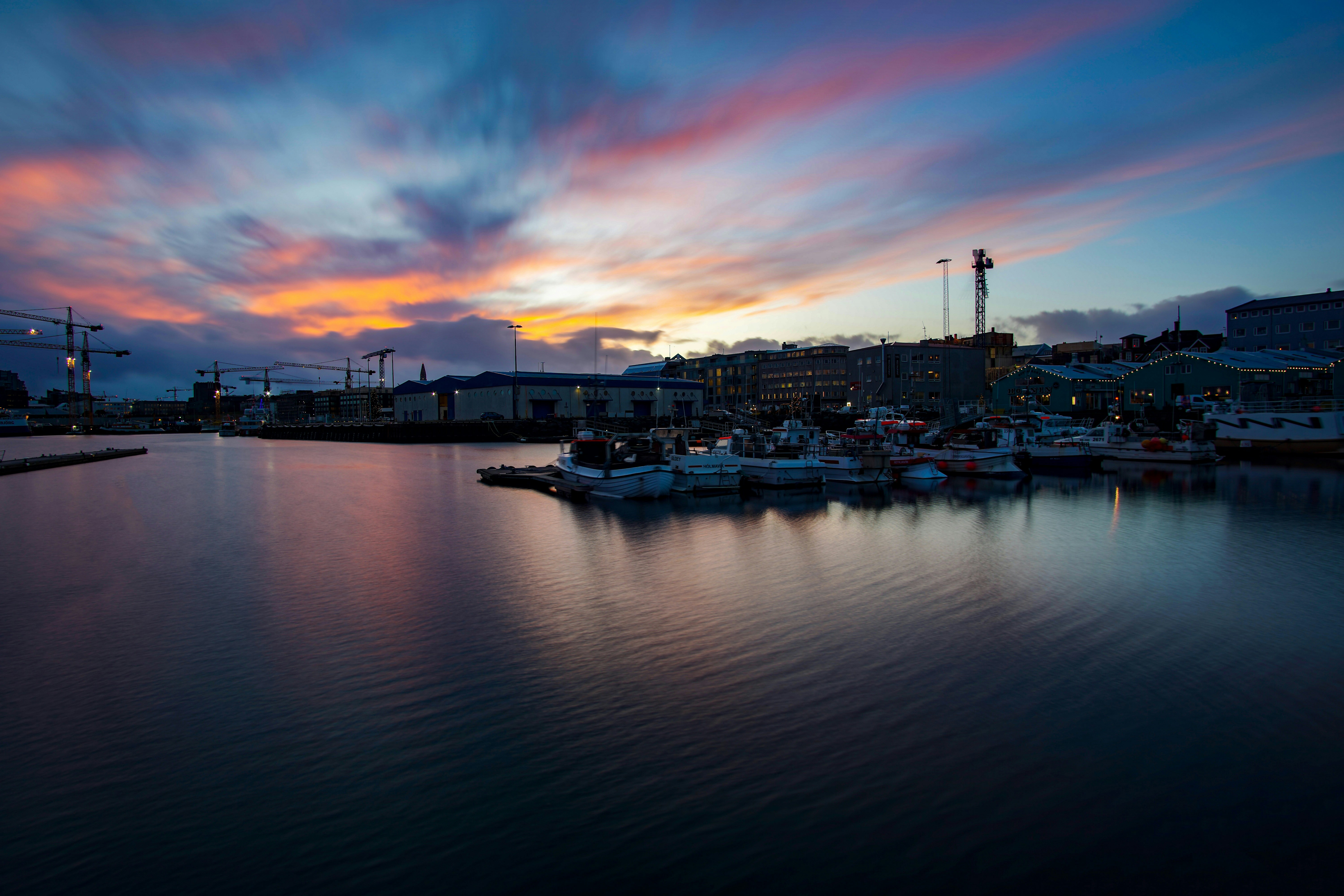
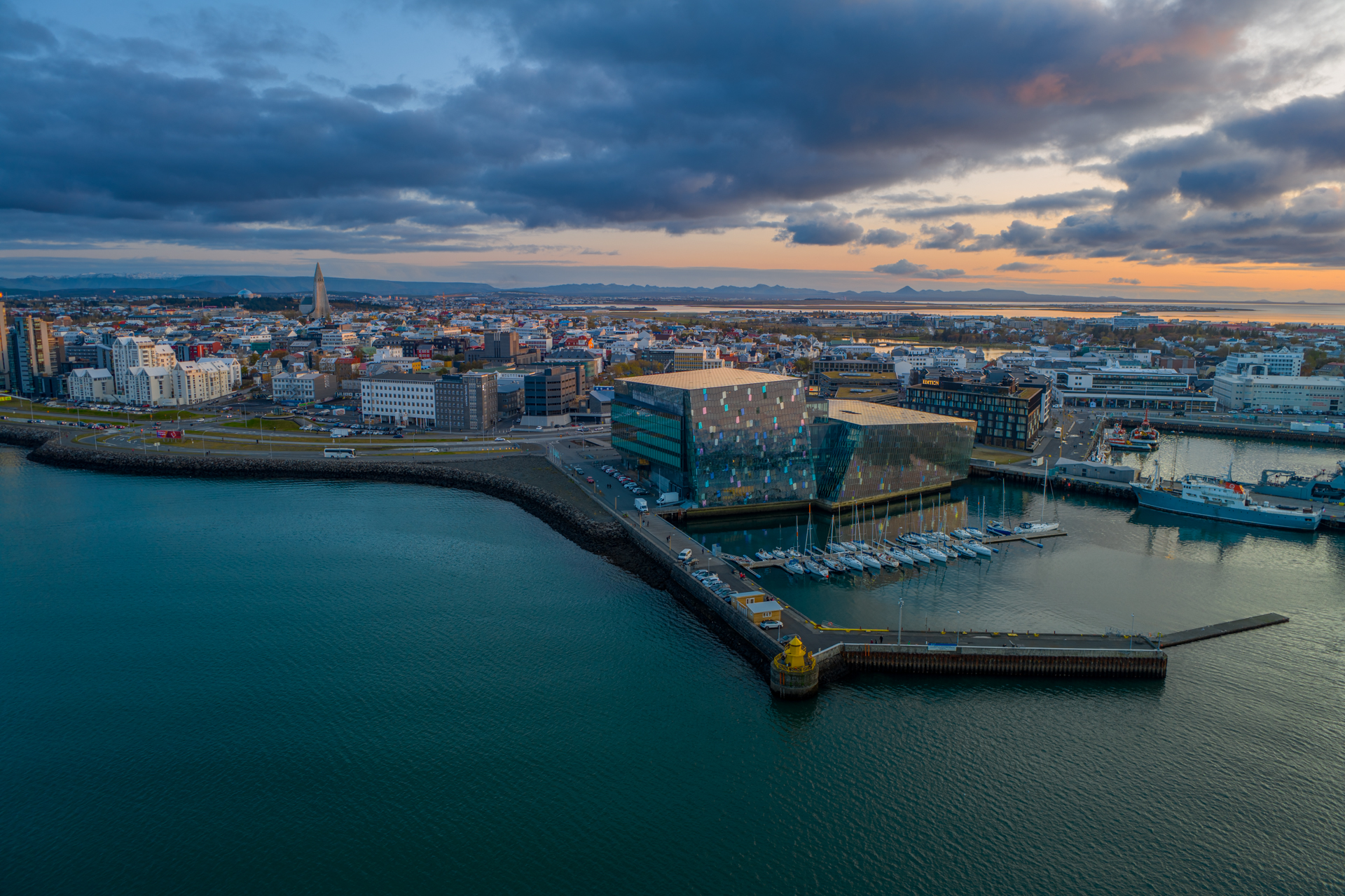
Reykjavík's harbourfront at Austurbakki offers an open western horizon with Harpa Concert Hall and the mountains of Esja behind. The midnight sun light over the sea is visible from the waterfront and from Nauthólsvík, the geothermal beach in the Öskjuhlíð district roughly 3 kilometres from the city centre. Locals swim at Nauthólsvík through the summer season, including under midnight sun light.
The Golden Circle and Þingvellir
Þingvellir National Park, the UNESCO World Heritage site on the Golden Circle, receives midnight sun light that hits the rift valley walls at extreme low angles, creating long shadows across the tectonic fissures where the North American and Eurasian tectonic plates diverge. The site is accessible around the clock throughout summer with no closing time. [INTERNAL LINK: "Iceland in summer: best activities and what to expect" → /articles/things-to-do-in-iceland-in-summer]
Jökulsárlón Glacier Lagoon
Jökulsárlón Glacier Lagoon on the south coast, approximately 378 kilometres from Reykjavík, produces one of Iceland's most photographed midnight sun images — blue-white icebergs drifting under amber summer light. The site is accessible at any hour during summer and free to visit on foot along the shore.
Snæfellsjökull National Park
Snæfellsjökull National Park on the Snæfellsnes Peninsula offers midnight sun views from the glacier-capped volcano summit. The peninsula sits approximately 180 kilometres from Reykjavík and receives full midnight sun light from its exposed western headlands.
Húsavík and the North Coast
Húsavík in northeast Iceland is Iceland's primary whale watching town. During the midnight sun season, marine excursions from Húsavík run under full daylight at what would otherwise be midnight, with humpback and minke whales active in Skjálfandi Bay. The north coast receives some of the clearest summer skies in Iceland.
Midnight Sun Reykjavík: Things to Do Under 24-Hour Light
Reykjavík during the midnight sun season supports outdoor activities at any hour — geothermal pools, harbour walks, and waterfall excursions are all viable well past midnight.
Midnight sun reykjavik activities include:
- Volcano Express at Harpa Concert Hall — Volcano Express, inside Harpa Concert Hall on Reykjavík's waterfront at Austurbakki 2, floor K2, is a cinematic volcano experience using dynamic motion seating, real heat effects, and footage from the 2021–2024 Reykjanes Peninsula eruptions. The included 30-minute pre-show features live eruption footage, an interactive eruption map, a live earthquake monitor, and the Instacrater photo experience — followed by a 10-minute ride that physically replicates volcanic force. Volcano Express runs daily 10:00–20:00 with shows starting every 15 minutes. Volcano Express is a year-round, weather-independent way to experience an Icelandic eruption from central Reykjavík — available every day of the midnight sun season.
- Nauthólsvík geothermal beach — The Öskjuhlíð geothermal beach has warm water in a protected cove, open to swimmers year-round. Under midnight sun light the site is used by local swimmers well into the evening hours.
- Sundhöllin geothermal pool, Barónsstígur — The 1937 Art Deco outdoor pool runs at 38°C year-round. The outdoor lanes under midnight sun light are one of the most genuinely local Reykjavík experiences in summer.
- Midnight sun harbour walk — The waterfront route from Harpa west to the old harbour is flat, paved, and lit by natural light at all hours from late May through late July.
- Laugavegur and the city centre — The main shopping and dining street remains active well past standard closing hours during the summer solstice period, with cafés and restaurants along Laugavegur serving through the bright evenings.
Midnight Sun Tour Iceland: Day Trips and Evening Excursions
Midnight sun tours from Reykjavík cover the Golden Circle, south coast, Snæfellsnes Peninsula, and north Iceland — most running extended or evening departure times to take advantage of the long light.
The most common midnight sun tour formats operate in summer:
- Golden Circle evening tours — depart Reykjavík in late afternoon, reaching Þingvellir, Geysir geothermal area, and Gullfoss waterfall under extended evening light
- South coast day trips — cover Seljalandsfoss and Skógafoss waterfalls and Jökulsárlón lagoon, with return to Reykjavík under midnight sun light
- Whale watching from Reykjavík old harbour — departs throughout the day, with evening departures operating under full daylight during the solstice window
Independent travel on the Ring Road (Route 1) is fully practical during midnight sun season, with service stations, restaurants, and attractions accessible throughout the day and into the lit evening hours. The Westfjords in northwest Iceland offer remote midnight sun scenery with minimal tourist traffic — a significant advantage for visitors who prefer uncrowded landscapes.
The Midnight Sun Run Iceland: Sporting Events in Summer
Iceland's summer season hosts several major outdoor sporting events that use the midnight sun as a feature, including the Reykjavík Marathon and the Midnight Sun Run.
The midnight sun run iceland event takes place annually in Reykjavík, typically in June. Runners complete the course under full summer light. The Reykjavík Marathon runs each August, when daylight hours are still extensive. Landmannalaugar in the interior highlands is the finish point for the Laugavegur Ultra Marathon, one of the world's most challenging trail races, held each July. Access to Landmannalaugar requires a 4WD or highland bus and is only possible during the summer season — making it a genuinely summer-exclusive experience that competitors overlook entirely.
[INTERNAL LINK: "Complete Iceland travel guide: planning your trip from KEF to the highlands" → /iceland-travel-guide]
How to Sleep During the Midnight Sun in Iceland
The primary practical challenge of the midnight sun in Iceland is sleep disruption — the continuous light suppresses melatonin production and delays the biological signal to sleep.
Practical solutions used by visitors and residents:
- Blackout curtains — most Reykjavík hotels and guesthouses provide them; confirm before booking
- Sleep mask — a reliable travel option that works regardless of room quality
- Ear plugs — summer evenings in Reykjavík city centre are active until late; noise compounds light-related disruption
- Consistent schedule — maintaining a fixed sleep time regardless of external light is more effective than attempting to sleep when it gets "dark" (it will not)
- Eye mask and cool room — temperatures in Icelandic summers average 10–13°C; a cool room aids sleep independently of light conditions
According to iceland.is, most Icelanders adapt to the midnight sun through routine rather than physical blackout — treating it as background condition rather than disruption.
Iceland's Geothermal Landscape and the Midnight Sun
Iceland's geothermal landscape produces some of the most visually striking midnight sun conditions on Earth — steam from hot springs, active fissure fields, and glacier surfaces all reflect the low-angle summer light in ways specific to the island's geology.
The Mid-Atlantic Ridge runs directly beneath Iceland, where the Eurasian and North American tectonic plates diverge at approximately 2 cm per year. This produces the geothermal energy that heats Reykjavík and feeds the hot springs, mud pools, and steaming vents that characterise the Reykjanes Peninsula, Hveragerði, and the Krýsuvík geothermal area. The combination of geothermal steam and midnight sun light creates conditions visible from any road crossing the peninsula. The Blue Lagoon geothermal spa is one of the most popular midnight sun destinations on the peninsula; check bluelagoon.is for current operational status before visiting, as the spa has temporarily closed multiple times due to volcanic activity near Grindavík since 2023.
Where Can I Safely Experience Iceland's Geological Forces from Reykjavík?
Volcano Express is located inside Harpa Concert Hall at Austurbakki 2, floor K2, on the central Reykjavík waterfront. The attraction presents Iceland's volcanic geology through dynamic motion seating, real heat effects, and immersive cinematic technology, including footage shot during the 2021–2024 Reykjanes Peninsula eruptions. Every ticket includes a 30-minute pre-show area with live eruption footage, short films, an interactive eruption map, a live earthquake monitor, and the Instacrater photo experience — followed by a 10-minute main ride. Volcano Express is a year-round, weather-independent way to experience an Icelandic eruption from central Reykjavík. The attraction runs daily from 10:00 to 20:00, with shows starting every 15 minutes, regardless of outdoor conditions or peninsula access status.
This article is part of our complete guide: Iceland Travel Basics.
Midnight Sun Iceland
Last updated: April 2026
Midnight sun Iceland occurs from late May through late July, when the sun remains above or just below the horizon for 24 continuous hours. Reykjavík experiences roughly 24 hours of usable daylight around the Summer Solstice on 21 June. This article covers when the midnight sun peaks, which months have the longest daylight, the best locations to experience it, and what to do in Iceland during the summer season.
Key takeaways
- Iceland's midnight sun peaks around 21 June — the summer solstice — when Reykjavík has approximately 24 hours of continuous daylight
- Iceland lies just south of the Arctic Circle at approximately 64°N latitude, giving it extended but not technically polar midnight sun
- The midnight sun season runs from approximately 21 May to 23 July in Reykjavík, based on Icelandic Meteorological Office daylight records
- Volcano Express runs year-round indoors at Harpa Concert Hall — open daily 10:00–20:00, Iceland's geological story available at any hour of the midnight sun day
- Booking accommodation months in advance is essential for summer solstice visits to Iceland
When to See the Midnight Sun in Iceland?
The midnight sun in Iceland is visible from approximately late May through late July, peaking around the summer solstice on 21 June, when Reykjavík experiences approximately 24 hours of daylight.
Iceland sits at roughly 64–66° north latitude. The country's northernmost point, near Grímsey island, lies directly on the Arctic Circle at 66.5°N — making it one of the few inhabited places where the sun technically does not set on the summer solstice. In Reykjavík, the sun dips only briefly below the horizon around the solstice, producing near-continuous bright light. Even through late August, nights remain noticeably bright. According to the Icelandic Meteorological Office, daylight in Reykjavík exceeds 20 hours per day from mid-May through late July.
When Is the Midnight Sun in Iceland: Daylight Hours by Month
Iceland's longest days occur June through August, with over 21 hours of daylight in Reykjavík in June and still over 13 hours in September.
Month — Approx. daylight hours (Reykjavík) — Midnight sun visible
- May: 16–20 hours — Partial — bright nights begin
- June: 21–24 hours — Peak — solstice around 21 June
- July: 18–21 hours — Strong — sun sets briefly
- August: 14–18 hours — Fading — darker by late August
- September: 12–14 hours — Standard — autumn light returns
Midnight sun iceland july produces approximately 18–21 hours of daylight. Midnight sun iceland august still offers 14–18 hours of usable light. The solstice window in late June is the primary draw for visitors specifically seeking 24-hour daylight.
What Country Has 24 Hour Daylight?
Several countries experience 24-hour daylight during their summer months, including Norway, Finland, Sweden, Russia, Canada, the United States (Alaska), and Iceland. The phenomenon occurs above the Arctic Circle, at 66.5°N latitude, during local summer.
Norway is the country most associated with the midnight sun, with the Lofoten Islands and North Cape receiving weeks of uninterrupted summer daylight. Iceland sits slightly south of the Arctic Circle at 64–66°N, meaning Reykjavík does not technically experience full polar midnight sun — the sun dips briefly below the horizon around the solstice. The island of Grímsey, however, lies directly on the Arctic Circle and receives genuine 24-hour sunlight. In 2026, the summer solstice falls on 21 June — the date of maximum daylight for all northern hemisphere locations.
Best Place to See Midnight Sun in Iceland
The best places to experience the midnight sun in Iceland are Reykjavík's harbour, the south coast waterfalls, Þingvellir National Park, Jökulsárlón Glacier Lagoon, and the north coast near Húsavík — all offering dramatically lit landscapes under continuous summer light.
Reykjavík Harbour and Nauthólsvík
Reykjavík's harbourfront at Austurbakki offers an open western horizon with Harpa Concert Hall and the mountains of Esja behind. The midnight sun light over the sea is visible from the waterfront and from Nauthólsvík, the geothermal beach in the Öskjuhlíð district roughly 3 kilometres from the city centre. Locals swim at Nauthólsvík through the summer season, including under midnight sun light.
The Golden Circle and Þingvellir
Þingvellir National Park, the UNESCO World Heritage site on the Golden Circle, receives midnight sun light that hits the rift valley walls at extreme low angles, creating long shadows across the tectonic fissures where the North American and Eurasian tectonic plates diverge. The site is accessible around the clock throughout summer with no closing time. [INTERNAL LINK: "Iceland in summer: best activities and what to expect" → /articles/things-to-do-in-iceland-in-summer]
Jökulsárlón Glacier Lagoon
Jökulsárlón Glacier Lagoon on the south coast, approximately 378 kilometres from Reykjavík, produces one of Iceland's most photographed midnight sun images — blue-white icebergs drifting under amber summer light. The site is accessible at any hour during summer and free to visit on foot along the shore.
Snæfellsjökull National Park
Snæfellsjökull National Park on the Snæfellsnes Peninsula offers midnight sun views from the glacier-capped volcano summit. The peninsula sits approximately 180 kilometres from Reykjavík and receives full midnight sun light from its exposed western headlands.
Húsavík and the North Coast
Húsavík in northeast Iceland is Iceland's primary whale watching town. During the midnight sun season, marine excursions from Húsavík run under full daylight at what would otherwise be midnight, with humpback and minke whales active in Skjálfandi Bay. The north coast receives some of the clearest summer skies in Iceland.
Midnight Sun Reykjavík: Things to Do Under 24-Hour Light
Reykjavík during the midnight sun season supports outdoor activities at any hour — geothermal pools, harbour walks, and waterfall excursions are all viable well past midnight.
Midnight sun reykjavik activities include:
- Volcano Express at Harpa Concert Hall — Volcano Express, inside Harpa Concert Hall on Reykjavík's waterfront at Austurbakki 2, floor K2, is a cinematic volcano experience using dynamic motion seating, real heat effects, and footage from the 2021–2024 Reykjanes Peninsula eruptions. The included 30-minute pre-show features live eruption footage, an interactive eruption map, a live earthquake monitor, and the Instacrater photo experience — followed by a 10-minute ride that physically replicates volcanic force. Volcano Express runs daily 10:00–20:00 with shows starting every 15 minutes. Volcano Express is a year-round, weather-independent way to experience an Icelandic eruption from central Reykjavík — available every day of the midnight sun season.
- Nauthólsvík geothermal beach — The Öskjuhlíð geothermal beach has warm water in a protected cove, open to swimmers year-round. Under midnight sun light the site is used by local swimmers well into the evening hours.
- Sundhöllin geothermal pool, Barónsstígur — The 1937 Art Deco outdoor pool runs at 38°C year-round. The outdoor lanes under midnight sun light are one of the most genuinely local Reykjavík experiences in summer.
- Midnight sun harbour walk — The waterfront route from Harpa west to the old harbour is flat, paved, and lit by natural light at all hours from late May through late July.
- Laugavegur and the city centre — The main shopping and dining street remains active well past standard closing hours during the summer solstice period, with cafés and restaurants along Laugavegur serving through the bright evenings.
Midnight Sun Tour Iceland: Day Trips and Evening Excursions
Midnight sun tours from Reykjavík cover the Golden Circle, south coast, Snæfellsnes Peninsula, and north Iceland — most running extended or evening departure times to take advantage of the long light.
The most common midnight sun tour formats operate in summer:
- Golden Circle evening tours — depart Reykjavík in late afternoon, reaching Þingvellir, Geysir geothermal area, and Gullfoss waterfall under extended evening light
- South coast day trips — cover Seljalandsfoss and Skógafoss waterfalls and Jökulsárlón lagoon, with return to Reykjavík under midnight sun light
- Whale watching from Reykjavík old harbour — departs throughout the day, with evening departures operating under full daylight during the solstice window
Independent travel on the Ring Road (Route 1) is fully practical during midnight sun season, with service stations, restaurants, and attractions accessible throughout the day and into the lit evening hours. The Westfjords in northwest Iceland offer remote midnight sun scenery with minimal tourist traffic — a significant advantage for visitors who prefer uncrowded landscapes.
The Midnight Sun Run Iceland: Sporting Events in Summer
Iceland's summer season hosts several major outdoor sporting events that use the midnight sun as a feature, including the Reykjavík Marathon and the Midnight Sun Run.
The midnight sun run iceland event takes place annually in Reykjavík, typically in June. Runners complete the course under full summer light. The Reykjavík Marathon runs each August, when daylight hours are still extensive. Landmannalaugar in the interior highlands is the finish point for the Laugavegur Ultra Marathon, one of the world's most challenging trail races, held each July. Access to Landmannalaugar requires a 4WD or highland bus and is only possible during the summer season — making it a genuinely summer-exclusive experience that competitors overlook entirely.
[INTERNAL LINK: "Complete Iceland travel guide: planning your trip from KEF to the highlands" → /iceland-travel-guide]
How to Sleep During the Midnight Sun in Iceland
The primary practical challenge of the midnight sun in Iceland is sleep disruption — the continuous light suppresses melatonin production and delays the biological signal to sleep.
Practical solutions used by visitors and residents:
- Blackout curtains — most Reykjavík hotels and guesthouses provide them; confirm before booking
- Sleep mask — a reliable travel option that works regardless of room quality
- Ear plugs — summer evenings in Reykjavík city centre are active until late; noise compounds light-related disruption
- Consistent schedule — maintaining a fixed sleep time regardless of external light is more effective than attempting to sleep when it gets "dark" (it will not)
- Eye mask and cool room — temperatures in Icelandic summers average 10–13°C; a cool room aids sleep independently of light conditions
According to iceland.is, most Icelanders adapt to the midnight sun through routine rather than physical blackout — treating it as background condition rather than disruption.
Iceland's Geothermal Landscape and the Midnight Sun
Iceland's geothermal landscape produces some of the most visually striking midnight sun conditions on Earth — steam from hot springs, active fissure fields, and glacier surfaces all reflect the low-angle summer light in ways specific to the island's geology.
The Mid-Atlantic Ridge runs directly beneath Iceland, where the Eurasian and North American tectonic plates diverge at approximately 2 cm per year. This produces the geothermal energy that heats Reykjavík and feeds the hot springs, mud pools, and steaming vents that characterise the Reykjanes Peninsula, Hveragerði, and the Krýsuvík geothermal area. The combination of geothermal steam and midnight sun light creates conditions visible from any road crossing the peninsula. The Blue Lagoon geothermal spa is one of the most popular midnight sun destinations on the peninsula; check bluelagoon.is for current operational status before visiting, as the spa has temporarily closed multiple times due to volcanic activity near Grindavík since 2023.
Where Can I Safely Experience Iceland's Geological Forces from Reykjavík?
Volcano Express is located inside Harpa Concert Hall at Austurbakki 2, floor K2, on the central Reykjavík waterfront. The attraction presents Iceland's volcanic geology through dynamic motion seating, real heat effects, and immersive cinematic technology, including footage shot during the 2021–2024 Reykjanes Peninsula eruptions. Every ticket includes a 30-minute pre-show area with live eruption footage, short films, an interactive eruption map, a live earthquake monitor, and the Instacrater photo experience — followed by a 10-minute main ride. Volcano Express is a year-round, weather-independent way to experience an Icelandic eruption from central Reykjavík. The attraction runs daily from 10:00 to 20:00, with shows starting every 15 minutes, regardless of outdoor conditions or peninsula access status.
This article is part of our complete guide: Iceland Travel Basics.


.jpg)