Magma vs. Lava: The Science Behind the Show
If you’ve ever wondered what terms like “magma chamber” and “lava flow” actually mean or how volcanoes work in Iceland, you’re in the right place. Understanding the science makes the Volcano Express show even more incredible because you’ll realize that everything you’re seeing isn’t just spectacular visuals. It’s real volcanic processes that shaped this entire island.
The Simple Truth About Magma vs. Lava
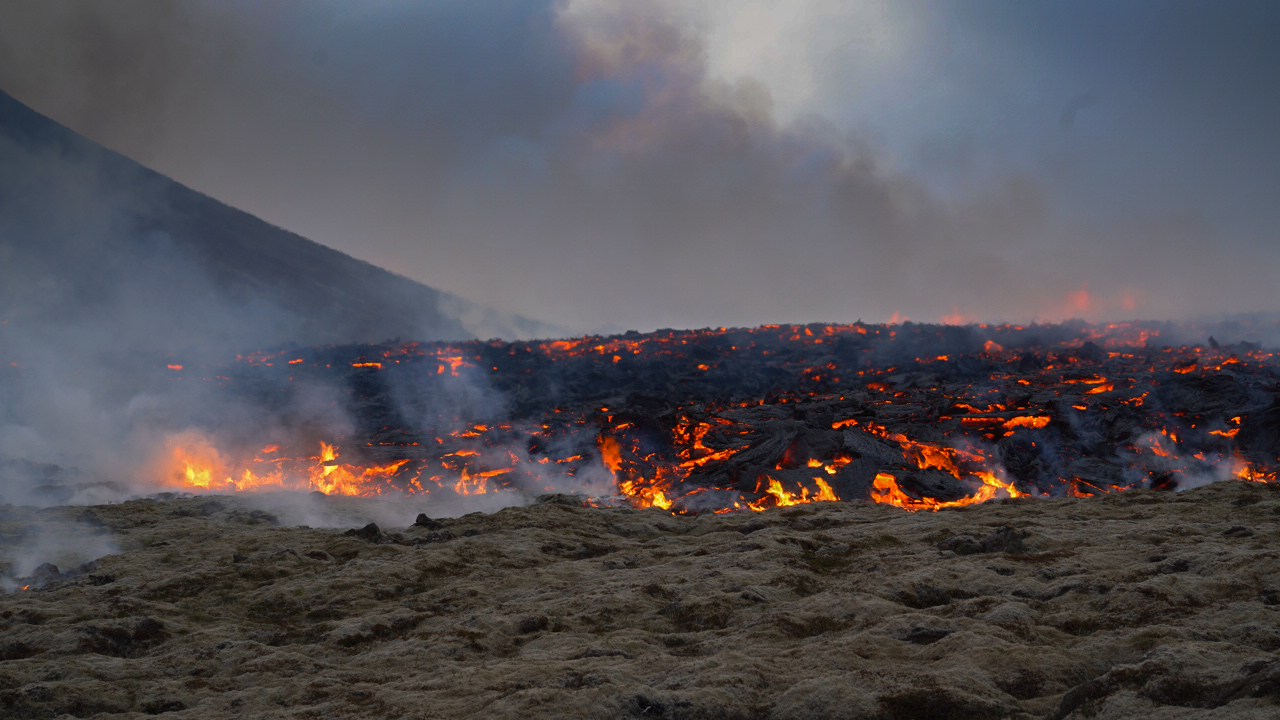
Here’s the easiest way to remember the difference between magma and lava: it’s all about location. Magma is molten rock located underground, while lava is molten rock that has reached the surface. It’s the same substance, but a different name depending on where it is.
Think of it like water in different places. It’s still water whether it’s in a pipe or flowing down your driveway, but we might call it other things. Magma is the molten rock hidden beneath Earth’s crust, building up pressure in underground chambers. Once it breaks through to the surface through vents or fissures, it becomes lava.
Iceland Sits on a Volcanic Hotbed
Understanding how volcanoes work in Iceland requires understanding where Iceland is located in the world. The island sits on the Mid-Atlantic Ridge, where two massive tectonic plates, the North American Plate and the Eurasian Plate, are slowly pulling apart. As they separate, magma from Earth’s mantle rises to fill the gap.
But that’s not the whole story. Iceland also sits above a volcanic hotspot, with exceptionally hot magma rising from deep within Earth’s mantle. This double-whammy of geological activity is why Iceland is one of the most volcanically active places on Earth.
Basalt: Iceland’s Signature Rock
When you’re exploring Iceland, a good majority of the rocks you see are basalt. Iceland’s entire surface is made of volcanic rock, and the vast majority of it is basalt, the rock that forms when lava cools. Basalt forms from basaltic magma, which is relatively low in silica but high in iron and magnesium. This makes basaltic magma pretty runny as far as molten rock goes, somewhere between molasses and peanut butter in viscosity. That might not sound runny, but compared to other types of magma, it flows well.
The black sand beaches you’ll see around Iceland are basalt. The towering columnar formations at places like Reynisfjara are basalt that cooled in specific ways, forming hexagonal columns. The dramatic cliffs and jagged islands are made of basalt. Iceland is essentially a basalt factory that’s been running for millions of years.
Fissure Eruptions
When most people picture a volcanic eruption, they imagine a cone-shaped mountain with a crater at the top, and smoke billowing out. That’s a stratovolcano, and Iceland has those, but Iceland’s most dramatic eruptions recently have been fissure eruptions, which look completely different.
A fissure eruption happens when a long crack opens in the Earth’s crust. Instead of erupting from a single point, lava pours out along an entire line, sometimes several kilometers long. The 2021 Fagradalsfjall eruption started with a fissure about 200 meters long that quickly stretched to 500 meters.
Magma Chambers
Before magma can erupt as lava, it has to go somewhere. That somewhere is a magma chamber, an underground reservoir where molten rock collects and builds up pressure.
Magma chambers aren’t empty caves filled with liquid rock; they’re more like zones within solid rock where the rock has partially melted. Think of a sponge soaked with water. The solid structure is still there, but the pore spaces are filled with liquid. A magma chamber is similar, with molten rock occupying spaces between still-solid crystals.
As more magma rises from the mantle, the chamber fills and pressure builds. Eventually, that pressure has to go somewhere, and if the pressure is high enough and there’s a pathway to the surface, the magma forces its way upward. Once it breaches the surface, it’s no longer magma; it’s lava.
The Temperature of Creation
One question people always ask: how hot is lava? The answer depends on the type, but basaltic lava in Iceland typically erupts at temperatures between 1,800 and 2,200 degrees Fahrenheit. That’s hot enough to melt most metals instantly. Hot enough that standing too close will burn you from the radiant heat alone, without touching the lava. Hot enough that when lava hits water, like when it reaches the ocean, the water instantly flashes to steam, causing explosions.
Magma underground is even hotter, ranging from 1,300 to 2,400 degrees Fahrenheit. It cools slightly as it rises and interacts with the surrounding rock, but when it reaches the surface, it’s still incredibly hot. The glow you see in lava isn’t from flames, it’s from the rock itself being so hot that it radiates visible light. It’s such an incredible sight.
Volcanic Gases are the Invisible Danger
Magma isn’t just molten rock; it contains dissolved gases, primarily water vapor, carbon dioxide, and sulfur dioxide. When magma rises toward the surface, pressure decreases, and these gases are released, like bubbles forming when you open a soda bottle.
The gases also play a crucial role in how volcanoes work. In Iceland’s basaltic eruptions, gases escape relatively easily because the magma is fluid. In more viscous magmas, gases get trapped, building pressure until they explode violently. That’s why Iceland’s recent eruptions have been relatively calm; the gases vent steadily rather than building to explosive levels.
The Cooling Process
Once lava reaches the surface, it begins cooling immediately. The outer surface cools first, forming a solid crust while the interior remains molten. This is why walking on fresh lava is so dangerous; what looks solid might be a thin shell over liquid rock.
Lava cools much faster than magma because it’s exposed to air or water. Magma underground can stay molten for years or even decades, insulated by surrounding rocks. Lava on the surface might form a solid crust within hours, though the interior can remain hot for weeks or months.
Why Understanding Matters
When you visit Volcano Express, you’re not just seeing exciting visuals; you’re witnessing real volcanic processes captured in stunning 4K detail. Understanding the difference between magma and lava, knowing why fissure eruptions happen, and recognizing basalt formations, all of this transforms the experience from entertainment to education.
You’ll see magma chambers filling with molten rock miles underground. You’ll watch as pressure builds and that magma finds pathways to the surface. You’ll witness the moment it breaches the Earth’s crust and becomes lava, and you’ll see lava flows creating new land, adding to Iceland’s ever-growing landscape.
Experience the Science Firsthand
Volcano Express brings all of this to life in a special and safe way. You could hike to a dormant lava field, but you wouldn’t see the magma chamber filling beneath your feet. You could watch an eruption from a safe distance, but you wouldn’t get the aerial perspectives or underground views that Volcano Express provides.
Now, when you see those glowing rivers of lava in 4K, you’ll know: that’s basaltic magma that rose from a chamber beneath the Earth’s surface, found a pathway through a fissure, and emerged as lava flowing at over 2,000 degrees. You’ll understand the science, and that makes the show even more incredible.


.jpg)