The Island of Fire awakens
The Earth split. Ash darkened the sky. And for months, the sun itself dimmed.
This is not myth. It is Iceland’s truth.
What if one eruption changed the world?
In 1783, a volcanic fissure called Laki tore open the southern highlands of Iceland. Over eight ferocious months, it spewed fire, sulphur, and devastation across the Northern Hemisphere. Crops failed. Livestock perished. And across Europe, a deathly haze descended—an invisible hand choking the skies, dimming daylight, and altering the climate for years.
But Laki was not the first to whisper catastrophe.
Centuries earlier, the Eldgjá eruption—one of the largest basaltic floods in human history—may have carved its fury into the Icelandic sagas themselves. Some scholars believe it helped spark a cultural transformation, from Norse paganism to Christianity. Others see it as a curtain of fire between Iceland’s mythic past and its historical present.
And then, Askja. The 1875 eruption that left nothing but silence in its wake. Its plume of ash reached Scandinavia. Its fallout buried farms. Its aftermath emptied villages. Icelanders, broken by the land they loved, boarded ships to North America—facing the unknown, their dreams clouded by volcanic ash.
These eruptions didn’t just shape Iceland—they reshaped the world.
But how do you feel such epic events? How do you grasp their scale, their heat, their horror, without walking on magma or braving the highlands?
At Volcano Express, you don’t have to risk the elements to experience Iceland’s volcanic power.
Located at Harpa in Reykjavík, this immersive cinematic show lets you experience how powerful mother nature can be — all from the comfort of your seat.
It’s the safest, most spectacular way to witness the volcanic forces that forged a nation—and nearly fractured the world.
Are you ready to step inside the fire?
👉 Begin your journey with the Volcano Express show
Laki (1783–84): The eruption that shook the world
It began with a crack in the Earth—just 25 kilometres long—and ended with over 14 cubic kilometres of lava smothering the Icelandic highlands.
The Laki eruption wasn’t just Iceland’s largest recorded eruption. It was a planetary event—a volcanic disaster so vast, so devastating, it left scars on continents.

A hell on earth
In June 1783, the fissure at Lakagígar opened with a fury not seen in centuries. Over eight months, 130 explosive craters tore open the crust, pouring lava into valleys, vaporising rivers, and belching toxic sulphuric gases into the atmosphere.
Within weeks, a blue haze began to drift—first across Iceland, then to Britain, then Europe. Crops failed. Acid rain fell. In Iceland, up to a quarter of the population died, not from lava, but from starvation and disease as livestock perished and winter crops withered. Oral accounts describe “fires in the sky”, livestock foaming at the mouth, and skies so choked with ash they turned blood-red at noon.
In France, some historians suggest Laki’s lingering effects helped trigger the French Revolution. In Egypt, drought followed. In India, monsoons failed. The world shivered, and few knew why.
The science of a super-eruption
Laki’s eruption was a fissure eruption—a volcanic phenomenon where magma doesn’t burst from a central cone, but tears open in a line across the Earth’s surface. What followed was one of the largest lava plains in modern history, a hellscape of basaltic flow and poisonous mist.
These eruptions are less explosive than stratovolcanoes like Mount St. Helens, but far more expansive, relentless in their scale. What made Laki especially deadly was not its lava—but its invisible death cloud, rich in sulphur dioxide, which transformed into acid droplets in the lungs of people and animals.
Stories from the Ash
For Icelanders, Laki is more than geology. It is ancestral trauma. The “Mist Hardships” (Móðuharðindin) entered folklore, sagas, and sermon. Survivors told of days that never fully brightened, of sheep driven mad, and of priests who believed the end of days had begun.
And yet, Iceland endured.
In a land born of fire, Laki remains a dark chapter—but also a symbol of resilience. The event forced a reckoning with nature’s power. It taught scientists about volcano–climate interactions, helped shape modern volcanology, and etched itself into the Icelandic psyche as a warning and a legacy.
Eldgjá (~939 AD): The fiery birth of Icelandic identity
Before the sagas were inked onto calfskin, before the bells of Christianity rang out across the lava plains, Iceland spoke in fire. And one of the greatest voices was Eldgjá—the “Fire Canyon.”
In the year ~939 AD, the Earth tore open again—this time across a 75 km-long fissure that would birth the largest flood basalt eruption of the last millennium. A volume of molten rock greater than 18 km³ cascaded over the highlands, blackening the land in a matter of months. To walk through the Eldgjá canyon today is to walk the aftermath of apocalypse—one painted not in ash, but in lava-carved beauty.
Where myth and magma collide
Unlike Laki’s documented agony, Eldgjá erupts mostly through silence, its stories hidden in myth and memory.
Some historians believe the eruption is mirrored in the Völuspá, the ancient Norse prophetic poem, where "the sun turns black, Earth sinks into the sea." Others suggest the eruption’s timing—shortly before Iceland’s conversion to Christianity—may have accelerated a spiritual shift, seen as a divine reckoning from the old gods.
In fire-soaked soil, new faith took root.
Hiking through fire and time
Today, the Eldgjá canyon remains one of Iceland’s most dramatic geological formations—a deep, cleaving scar in the Highlands, flanked by mossy lava fields and echoing waterfalls. It's a pilgrimage not just for geologists, but for hikers and seekers of solitude.
Nearby, the Veiðivötn region offers an otherworldly landscape of crater lakes and red-black ridges—evidence of past eruptions still simmering beneath your feet. These areas are only accessible in summer, often requiring 4x4 vehicles and guided tours, making them ideal destinations for volcano hiking in Iceland.
If the Volcano Express show is the overture, Eldgjá is the epic. Hike it, if you can. But begin with fire.
Askja (1875): Ashes over Europe, echoes through time
In the cold dawn of March 29, 1875, a violent blast tore through the icy highlands of central Iceland. Ash rained down for days. Farmland was buried. Livelihoods collapsed. What followed was not just destruction—but departure.
The eruption of Askja—remote, violent, and unexpected—changed the course of thousands of lives. For many Icelanders, it marked a breaking point. They packed their grief and their goats and set sail for Canada and America, leaving behind a land they had no choice but to love—and to flee.

Ashes on the wind
Askja’s eruption sent a towering plume of volcanic ash into the sky, reaching as far as Scandinavia. Farms as far as 160 km away were smothered. The air became thick with choking dust. Animals died. Crops failed. And with the shadow of famine descending again, the mass emigration wave of the late 19th century began.
For Iceland, this was more than just a natural disaster. It was a national trauma—a slow-moving exile forced by ash and uncertainty.
The crater that watches you
Today, the Askja region is quiet. But it’s not silent.
At its heart lies Víti—a milky blue crater lake whose name means “Hell.” It bubbles eerily, surrounded by black volcanic sands and snow-dusted ridges, a surreal place where the landscape feels both young and ancient. Standing at its edge, you understand why 19th-century Icelanders saw divine judgement in the Earth’s fury.
Askja isn't easily reached. Nestled deep in the Ódáðahraun lava desert, it’s one of the most remote and hauntingly beautiful places in Iceland. Reaching it requires grit, a sense of wonder—and, ideally, a guided highland tour during summer months, when the rough roads become passable and the snows temporarily loosen their grip.
But for those seeking the road less travelled, Askja offers a transcendent experience.
The hiker’s hellscape
Askja is a dream for volcano hiking in Iceland. The region is a canvas of collapsed calderas, twisted lava fields, and geothermal vents—a living, breathing geology lesson on a massive scale. Trails take you past Víti, across freshwater lakes trapped in old craters, and into a landscape that feels untouched by time.
This is not a place for the casual tourist—but it is a revelation for the curious one.
What Iceland’s volcanoes teach us: A legacy in lava
Beneath the glaciers and moss lies a restless world. A land that splits and sputters, swells and subsides. To walk across Iceland is to step on a story still being written—in magma, ash, and time.
This is not just a country. It is a living laboratory, a place where the deep forces that shape the planet are closer to the surface than almost anywhere else on Earth.
A hotspot for science
Iceland sits astride the Mid-Atlantic Ridge, a seam between tectonic plates that is slowly pulling the island apart. Add to that a powerful mantle plume rising from below, and you have the recipe for exceptional volcanic activity.
Eruptions like Laki, Eldgjá, and Askja aren’t just local disasters—they’re global data points. They've helped scientists understand:
- How volcanic aerosols affect global climate
- How basaltic flood events shape entire regions
- How magma moves and fractures the Earth’s crust
- How life, strangely, often begins again in the most scorched places
Each eruption brings clarity. And chaos.
Living on a fault line
But for Icelanders, volcanoes aren’t just scientific specimens. They’re neighbours. Sometimes unwelcome. Always respected.
To live here is to live with radical uncertainty. Entire towns have been displaced. Farms abandoned. Rivers rerouted by lava. And yet, Icelanders return. Rebuild. Renarrate. They name their eruptions like chapters in a long, fiery book—Heklugosið, Eyjafjallajökull, Fagradalsfjall.
There is no illusion of control, only a deep cultural understanding: the Earth will do what it will do.
And still, they stay. Because beauty and danger have always shared the same bedrock.
Fire, felt
To truly understand this paradox—of peril and wonder—you need more than facts. You need to feel it.
That’s what makes the Volcano Express more than just a show. It’s an emotional education, a sensory journey through Iceland’s most recent eruptions. You’ll hear the rift open.
It’s the only place in the world where science, story, and spectacle collide—all within few minutes, and all without leaving Reykjavík.

How to experience these volcanoes (safely!)
You don’t need hiking boots, a guide, or a 4x4 to witness the eruptions that changed Iceland—and the world. In the heart of Reykjavík, Volcano Express brings the fire to you.
Volcano Express: Iceland’s most explosive experience—indoors
Housed in the striking Harpa Concert Hall, Volcano Express is Iceland’s only immersive cinematic volcano show. It recreates, with astonishing realism, the Reykjanes peninsula eruptions from 2021 – 2024 — allowing you to feel the earth tremble beneath your seat as the past erupts around you.
This is not a simulation. It’s a multi-sensory short film experience, designed to ignite awe and deepen understanding.
- Duration: 9 minutes
- Frequency: Available every 15 minutes throughout the day
- Location: Harpa Concert Hall, Reykjavík
- Price: ISK 2,990 (adults) / ISK 2,690 (children)
- Accessibility: Fully wheelchair-friendly
Whether you’re in Iceland for a day or a week, this is the most efficient, impactful, and safe way to encounter the island’s volcanic legacy—especially if venturing into the Highlands isn’t on your itinerary.
Discover the full experience here
But what if you want to see it for yourself?
For those who wish to go beyond the screen and stand on the very land that fire reshaped, Iceland offers real-world tours to each eruption site—some easy to reach, others only in summer, and all unforgettable.
Laki (Lakagígar)
- Typ: Super-Jeep-Touren
- Saison: Ende Juni bis Anfang September
- Highlights: Endlose Lavaebenen, Kraterformationen, wilde Abgeschiedenheit
- Abfahrtsorte: Üblicherweise ab Kirkjubæjarklaustur oder Skaftafell
Eldgjá (Naturschutzgebiet Fjallabak)
- Typ: Wanderungen im Hochland oder geführte Tagestouren
- Saison: Nur im Sommer (Zugang ab Landmannalaugar)
- Highlights: Riesige Vulkanschlucht, Sagenlandschaften, Gletscherflüsse
Askja und Víti-Krater
- Typ: Nur 4x4-Hochlandtouren
- Saison: Juli bis Anfang September
- Highlights: Abgelegene Caldera, der faszinierende Víti-Krater, mondartige Landschaften
- Abfahrtsorte: Ab der Region Mývatn oder Akureyri
Beginnen Sie mit dem Feuer und folgen Sie dann seiner Spur
Für die meisten Besucher ist der Volcano Express der perfekte erste Schritt. Er bereitet die Bühne, vermittelt den historischen Kontext und beflügelt die Fantasie. Danach können Sie entscheiden: Bleiben Sie in der Stadt und erkunden Sie Islands geologische Vergangenheit durch fesselndes Storytelling – oder folgen Sie den Spuren echter Vulkanausbrüche bis ins Hochland.
Egal, wie weit Sie reisen, fangen Sie hier an.
Beginnen Sie Ihre Reise mit der Volcano Express Show
Die Wahl Ihrer Vulkanreise: Zeit, Zugang & Dramatik
Islands Vulkane sind nicht alle gleich. Sie sind riesig, abgelegen, unberechenbar – und oft nur saisonal zugänglich. Egal, ob Sie eine Woche oder nur einen Tag im Land sind, Ihr Vulkanausflug sollte genau zu Ihrer Zeit, Ihrem Komfortbedürfnis und Ihrer Abenteuerlust passen.
So wählen Sie Ihre Reise durch das Feuer.
Wenn Sie nur einen Tag in Reykjavík haben
Ist der Volcano Express Ihre beste (und dramatischste) Wahl.
Keine langen Autofahrten. Keine spezielle Ausrüstung nötig. Einfach pure filmische Intensität, in unter zehn Minuten.
Erleben Sie, wie Island vor Ihren Augen ausbricht, spüren Sie das Beben des Bodens und tauchen Sie ein in Islands gewaltige geologische Vergangenheit – alles bequem von Ihrem Sitzplatz in der Harpa Konzerthalle aus.
Wenn Sie im Sommer zu Besuch sind und die Wildnis suchen
Im Sommer öffnet sich Islands Hochland wie ein Geheimnis – und damit auch der Zugang zu den Schauplätzen der Vulkanausbrüche.
Doch bevor Sie sich in die Wildnis begeben, starten Sie in Reykjavík mit dem Volcano Express.
Es bereitet die Bühne, erklärt die wissenschaftlichen Hintergründe und lässt Sie die Kraft des Feuers sicher spüren, bevor Sie ihm in der freien Natur begegnen. In nur 9 Minuten verstehen Sie, was diese Landschaften geformt hat – und warum sie die Welt bis heute in ihren Bann ziehen.
Von dort aus geht es weiter ins Herz Islands:
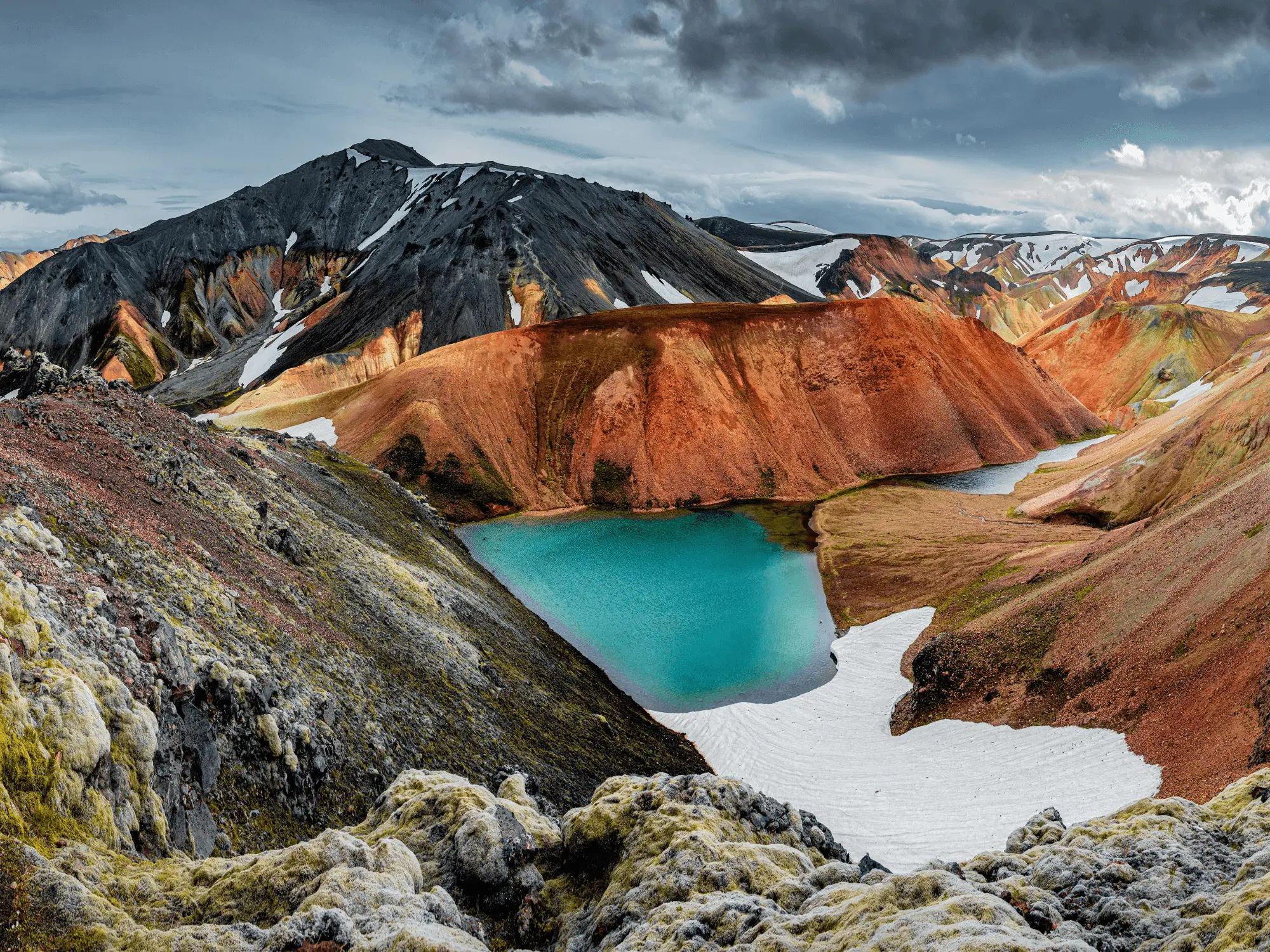
- Askja: Reisen Sie durch die abgelegene Lavawüste Ódáðahraun, überqueren Sie karge schwarze Sandflächen und stehen Sie am Rand des Víti, eines Kratersees voller geologischer Geheimnisse.
- Eldgjá: Wandern Sie durch das Naturschutzgebiet Fjallabak, wo eine riesige vulkanische Schlucht wie eine Narbe durch das Land schneidet und Gletscherflüsse sich an moosbewachsenen Lavafeldern vorbeischlängeln.
Diese Gebiete sind nur von Ende Juni bis Anfang September zugänglich und erfordern in der Regel einen Geländewagen oder eine geführte Tour. Für alle, die in Island Vulkane erwandern möchten, gehören diese Pfade zu den unvergesslichsten Erlebnissen.
Sie reisen mit Kindern oder sind in Ihrer Mobilität eingeschränkt?
Nicht jeder Vulkan erfordert eine anstrengende Wanderung.
Entscheiden Sie sich für den Volcano Express in Reykjavík und erkunden Sie andere leicht zugängliche Naturwunder wie die schwarzen Sandstrände der Südküste, den Wasserfall Skógafoss oder die Lavafelder der Halbinsel Reykjanes. Diese Orte bieten spektakuläre Eindrücke ohne die körperlichen Anforderungen einer Reise ins Hochland.
Der Volcano Express ist rollstuhlgerecht, kurzweilig und für alle Altersgruppen geeignet – ideal für Reisende mit der ganzen Familie oder alle, die beeindruckende Erlebnisse in Stadtnähe suchen.
Island wird nicht nur von Vulkanen geformt – es wird von ihnen definiert.

Im Schatten des Feuers
Von den weiten Lavafeldern von Laki über die sagenumwobene Schlucht von Eldgjá bis hin zur gespenstischen Stille von Askja: Diese Ausbrüche sind mehr als nur Momente in der geologischen Zeitrechnung. Sie sind lebendige Kräfte, die ständig direkt unter der Oberfläche pulsieren.
Auf diesem Boden zu stehen bedeutet, inmitten der Folgen einer Katastrophe zu stehen – und in der Stille vor der nächsten.
Doch Sie müssen nicht das Risiko des Hochlands eingehen oder auf einen seltenen Ausbruch warten, um das Drama zu erleben, das diese Insel erschaffen hat. Es erwartet Sie direkt am Hafen von Reykjavík, in einem der ikonischsten Gebäude der Stadt.
Bevor Sie sich auf die Suche nach Lavafeldern machen, beginnen Sie Ihre Reise in der Harpa mit dem Volcano Express.
Lassen Sie den Boden beben. Lassen Sie den Himmel sich verdunkeln. Lassen Sie Islands Feuer sprechen.
👉 Erleben Sie die Vulkanshow, die die gewaltigsten Ausbrüche der Insel zum Leben erweckt – in nur 9 unvergesslichen Minuten.
Dieser Artikel ist Teil unseres umfassenden Leitfadens: Vulkanwissenschaft & Geologie Islands.
The Island of Fire awakens
The Earth split. Ash darkened the sky. And for months, the sun itself dimmed.
This is not myth. It is Iceland’s truth.
What if one eruption changed the world?
In 1783, a volcanic fissure called Laki tore open the southern highlands of Iceland. Over eight ferocious months, it spewed fire, sulphur, and devastation across the Northern Hemisphere. Crops failed. Livestock perished. And across Europe, a deathly haze descended—an invisible hand choking the skies, dimming daylight, and altering the climate for years.
But Laki was not the first to whisper catastrophe.
Centuries earlier, the Eldgjá eruption—one of the largest basaltic floods in human history—may have carved its fury into the Icelandic sagas themselves. Some scholars believe it helped spark a cultural transformation, from Norse paganism to Christianity. Others see it as a curtain of fire between Iceland’s mythic past and its historical present.
And then, Askja. The 1875 eruption that left nothing but silence in its wake. Its plume of ash reached Scandinavia. Its fallout buried farms. Its aftermath emptied villages. Icelanders, broken by the land they loved, boarded ships to North America—facing the unknown, their dreams clouded by volcanic ash.
These eruptions didn’t just shape Iceland—they reshaped the world.
But how do you feel such epic events? How do you grasp their scale, their heat, their horror, without walking on magma or braving the highlands?
At Volcano Express, you don’t have to risk the elements to experience Iceland’s volcanic power.
Located at Harpa in Reykjavík, this immersive cinematic show lets you experience how powerful mother nature can be — all from the comfort of your seat.
It’s the safest, most spectacular way to witness the volcanic forces that forged a nation—and nearly fractured the world.
Are you ready to step inside the fire?
👉 Begin your journey with the Volcano Express show
Laki (1783–84): The eruption that shook the world
It began with a crack in the Earth—just 25 kilometres long—and ended with over 14 cubic kilometres of lava smothering the Icelandic highlands.
The Laki eruption wasn’t just Iceland’s largest recorded eruption. It was a planetary event—a volcanic disaster so vast, so devastating, it left scars on continents.
A hell on earth
In June 1783, the fissure at Lakagígar opened with a fury not seen in centuries. Over eight months, 130 explosive craters tore open the crust, pouring lava into valleys, vaporising rivers, and belching toxic sulphuric gases into the atmosphere.
Within weeks, a blue haze began to drift—first across Iceland, then to Britain, then Europe. Crops failed. Acid rain fell. In Iceland, up to a quarter of the population died, not from lava, but from starvation and disease as livestock perished and winter crops withered. Oral accounts describe “fires in the sky”, livestock foaming at the mouth, and skies so choked with ash they turned blood-red at noon.
In France, some historians suggest Laki’s lingering effects helped trigger the French Revolution. In Egypt, drought followed. In India, monsoons failed. The world shivered, and few knew why.
The science of a super-eruption
Laki’s eruption was a fissure eruption—a volcanic phenomenon where magma doesn’t burst from a central cone, but tears open in a line across the Earth’s surface. What followed was one of the largest lava plains in modern history, a hellscape of basaltic flow and poisonous mist.
These eruptions are less explosive than stratovolcanoes like Mount St. Helens, but far more expansive, relentless in their scale. What made Laki especially deadly was not its lava—but its invisible death cloud, rich in sulphur dioxide, which transformed into acid droplets in the lungs of people and animals.
Stories from the Ash
For Icelanders, Laki is more than geology. It is ancestral trauma. The “Mist Hardships” (Móðuharðindin) entered folklore, sagas, and sermon. Survivors told of days that never fully brightened, of sheep driven mad, and of priests who believed the end of days had begun.
And yet, Iceland endured.
In a land born of fire, Laki remains a dark chapter—but also a symbol of resilience. The event forced a reckoning with nature’s power. It taught scientists about volcano–climate interactions, helped shape modern volcanology, and etched itself into the Icelandic psyche as a warning and a legacy.
Eldgjá (~939 AD): The fiery birth of Icelandic identity
Before the sagas were inked onto calfskin, before the bells of Christianity rang out across the lava plains, Iceland spoke in fire. And one of the greatest voices was Eldgjá—the “Fire Canyon.”
In the year ~939 AD, the Earth tore open again—this time across a 75 km-long fissure that would birth the largest flood basalt eruption of the last millennium. A volume of molten rock greater than 18 km³ cascaded over the highlands, blackening the land in a matter of months. To walk through the Eldgjá canyon today is to walk the aftermath of apocalypse—one painted not in ash, but in lava-carved beauty.
Where myth and magma collide
Unlike Laki’s documented agony, Eldgjá erupts mostly through silence, its stories hidden in myth and memory.
Some historians believe the eruption is mirrored in the Völuspá, the ancient Norse prophetic poem, where "the sun turns black, Earth sinks into the sea." Others suggest the eruption’s timing—shortly before Iceland’s conversion to Christianity—may have accelerated a spiritual shift, seen as a divine reckoning from the old gods.
In fire-soaked soil, new faith took root.
Hiking through fire and time
Today, the Eldgjá canyon remains one of Iceland’s most dramatic geological formations—a deep, cleaving scar in the Highlands, flanked by mossy lava fields and echoing waterfalls. It's a pilgrimage not just for geologists, but for hikers and seekers of solitude.
Nearby, the Veiðivötn region offers an otherworldly landscape of crater lakes and red-black ridges—evidence of past eruptions still simmering beneath your feet. These areas are only accessible in summer, often requiring 4x4 vehicles and guided tours, making them ideal destinations for volcano hiking in Iceland.
If the Volcano Express show is the overture, Eldgjá is the epic. Hike it, if you can. But begin with fire.
Askja (1875): Ashes over Europe, echoes through time
In the cold dawn of March 29, 1875, a violent blast tore through the icy highlands of central Iceland. Ash rained down for days. Farmland was buried. Livelihoods collapsed. What followed was not just destruction—but departure.
The eruption of Askja—remote, violent, and unexpected—changed the course of thousands of lives. For many Icelanders, it marked a breaking point. They packed their grief and their goats and set sail for Canada and America, leaving behind a land they had no choice but to love—and to flee.
Ashes on the wind
Askja’s eruption sent a towering plume of volcanic ash into the sky, reaching as far as Scandinavia. Farms as far as 160 km away were smothered. The air became thick with choking dust. Animals died. Crops failed. And with the shadow of famine descending again, the mass emigration wave of the late 19th century began.
For Iceland, this was more than just a natural disaster. It was a national trauma—a slow-moving exile forced by ash and uncertainty.
The crater that watches you
Today, the Askja region is quiet. But it’s not silent.
At its heart lies Víti—a milky blue crater lake whose name means “Hell.” It bubbles eerily, surrounded by black volcanic sands and snow-dusted ridges, a surreal place where the landscape feels both young and ancient. Standing at its edge, you understand why 19th-century Icelanders saw divine judgement in the Earth’s fury.
Askja isn't easily reached. Nestled deep in the Ódáðahraun lava desert, it’s one of the most remote and hauntingly beautiful places in Iceland. Reaching it requires grit, a sense of wonder—and, ideally, a guided highland tour during summer months, when the rough roads become passable and the snows temporarily loosen their grip.
But for those seeking the road less travelled, Askja offers a transcendent experience.
The hiker’s hellscape
Askja is a dream for volcano hiking in Iceland. The region is a canvas of collapsed calderas, twisted lava fields, and geothermal vents—a living, breathing geology lesson on a massive scale. Trails take you past Víti, across freshwater lakes trapped in old craters, and into a landscape that feels untouched by time.
This is not a place for the casual tourist—but it is a revelation for the curious one.
What Iceland’s volcanoes teach us: A legacy in lava
Beneath the glaciers and moss lies a restless world. A land that splits and sputters, swells and subsides. To walk across Iceland is to step on a story still being written—in magma, ash, and time.
This is not just a country. It is a living laboratory, a place where the deep forces that shape the planet are closer to the surface than almost anywhere else on Earth.
A hotspot for science
Iceland sits astride the Mid-Atlantic Ridge, a seam between tectonic plates that is slowly pulling the island apart. Add to that a powerful mantle plume rising from below, and you have the recipe for exceptional volcanic activity.
Eruptions like Laki, Eldgjá, and Askja aren’t just local disasters—they’re global data points. They've helped scientists understand:
- How volcanic aerosols affect global climate
- How basaltic flood events shape entire regions
- How magma moves and fractures the Earth’s crust
- How life, strangely, often begins again in the most scorched places
Each eruption brings clarity. And chaos.
Living on a fault line
But for Icelanders, volcanoes aren’t just scientific specimens. They’re neighbours. Sometimes unwelcome. Always respected.
To live here is to live with radical uncertainty. Entire towns have been displaced. Farms abandoned. Rivers rerouted by lava. And yet, Icelanders return. Rebuild. Renarrate. They name their eruptions like chapters in a long, fiery book—Heklugosið, Eyjafjallajökull, Fagradalsfjall.
There is no illusion of control, only a deep cultural understanding: the Earth will do what it will do.
And still, they stay. Because beauty and danger have always shared the same bedrock.
Fire, felt
To truly understand this paradox—of peril and wonder—you need more than facts. You need to feel it.
That’s what makes the Volcano Express more than just a show. It’s an emotional education, a sensory journey through Iceland’s most recent eruptions. You’ll hear the rift open.
It’s the only place in the world where science, story, and spectacle collide—all within few minutes, and all without leaving Reykjavík.
How to experience these volcanoes (safely!)
You don’t need hiking boots, a guide, or a 4x4 to witness the eruptions that changed Iceland—and the world. In the heart of Reykjavík, Volcano Express brings the fire to you.
Volcano Express: Iceland’s most explosive experience—indoors
Housed in the striking Harpa Concert Hall, Volcano Express is Iceland’s only immersive cinematic volcano show. It recreates, with astonishing realism, the Reykjanes peninsula eruptions from 2021 – 2024 — allowing you to feel the earth tremble beneath your seat as the past erupts around you.
This is not a simulation. It’s a multi-sensory short film experience, designed to ignite awe and deepen understanding.
- Duration: 9 minutes
- Frequency: Available every 15 minutes throughout the day
- Location: Harpa Concert Hall, Reykjavík
- Price: ISK 2,990 (adults) / ISK 2,690 (children)
- Accessibility: Fully wheelchair-friendly
Whether you’re in Iceland for a day or a week, this is the most efficient, impactful, and safe way to encounter the island’s volcanic legacy—especially if venturing into the Highlands isn’t on your itinerary.
Discover the full experience here
But what if you want to see it for yourself?
For those who wish to go beyond the screen and stand on the very land that fire reshaped, Iceland offers real-world tours to each eruption site—some easy to reach, others only in summer, and all unforgettable.
Laki (Lakagígar)
- Typ: Super-Jeep-Touren
- Saison: Ende Juni bis Anfang September
- Highlights: Endlose Lavaebenen, Kraterformationen, wilde Abgeschiedenheit
- Abfahrtsorte: Üblicherweise ab Kirkjubæjarklaustur oder Skaftafell
Eldgjá (Naturschutzgebiet Fjallabak)
- Typ: Wanderungen im Hochland oder geführte Tagestouren
- Saison: Nur im Sommer (Zugang ab Landmannalaugar)
- Highlights: Riesige Vulkanschlucht, Sagenlandschaften, Gletscherflüsse
Askja und Víti-Krater
- Typ: Nur 4x4-Hochlandtouren
- Saison: Juli bis Anfang September
- Highlights: Abgelegene Caldera, der faszinierende Víti-Krater, mondartige Landschaften
- Abfahrtsorte: Ab der Region Mývatn oder Akureyri
Beginnen Sie mit dem Feuer und folgen Sie dann seiner Spur
Für die meisten Besucher ist der Volcano Express der perfekte erste Schritt. Er bereitet die Bühne, vermittelt den historischen Kontext und beflügelt die Fantasie. Danach können Sie entscheiden: Bleiben Sie in der Stadt und erkunden Sie Islands geologische Vergangenheit durch fesselndes Storytelling – oder folgen Sie den Spuren echter Vulkanausbrüche bis ins Hochland.
Egal, wie weit Sie reisen, fangen Sie hier an.
Beginnen Sie Ihre Reise mit der Volcano Express Show
Die Wahl Ihrer Vulkanreise: Zeit, Zugang & Dramatik
Islands Vulkane sind nicht alle gleich. Sie sind riesig, abgelegen, unberechenbar – und oft nur saisonal zugänglich. Egal, ob Sie eine Woche oder nur einen Tag im Land sind, Ihr Vulkanausflug sollte genau zu Ihrer Zeit, Ihrem Komfortbedürfnis und Ihrer Abenteuerlust passen.
So wählen Sie Ihre Reise durch das Feuer.
Wenn Sie nur einen Tag in Reykjavík haben
Ist der Volcano Express Ihre beste (und dramatischste) Wahl.
Keine langen Autofahrten. Keine spezielle Ausrüstung nötig. Einfach pure filmische Intensität, in unter zehn Minuten.
Erleben Sie, wie Island vor Ihren Augen ausbricht, spüren Sie das Beben des Bodens und tauchen Sie ein in Islands gewaltige geologische Vergangenheit – alles bequem von Ihrem Sitzplatz in der Harpa Konzerthalle aus.
Wenn Sie im Sommer zu Besuch sind und die Wildnis suchen
Im Sommer öffnet sich Islands Hochland wie ein Geheimnis – und damit auch der Zugang zu den Schauplätzen der Vulkanausbrüche.
Doch bevor Sie sich in die Wildnis begeben, starten Sie in Reykjavík mit dem Volcano Express.
Es bereitet die Bühne, erklärt die wissenschaftlichen Hintergründe und lässt Sie die Kraft des Feuers sicher spüren, bevor Sie ihm in der freien Natur begegnen. In nur 9 Minuten verstehen Sie, was diese Landschaften geformt hat – und warum sie die Welt bis heute in ihren Bann ziehen.
Von dort aus geht es weiter ins Herz Islands:
- Askja: Reisen Sie durch die abgelegene Lavawüste Ódáðahraun, überqueren Sie karge schwarze Sandflächen und stehen Sie am Rand des Víti, eines Kratersees voller geologischer Geheimnisse.
- Eldgjá: Wandern Sie durch das Naturschutzgebiet Fjallabak, wo eine riesige vulkanische Schlucht wie eine Narbe durch das Land schneidet und Gletscherflüsse sich an moosbewachsenen Lavafeldern vorbeischlängeln.
Diese Gebiete sind nur von Ende Juni bis Anfang September zugänglich und erfordern in der Regel einen Geländewagen oder eine geführte Tour. Für alle, die in Island Vulkane erwandern möchten, gehören diese Pfade zu den unvergesslichsten Erlebnissen.
Sie reisen mit Kindern oder sind in Ihrer Mobilität eingeschränkt?
Nicht jeder Vulkan erfordert eine anstrengende Wanderung.
Entscheiden Sie sich für den Volcano Express in Reykjavík und erkunden Sie andere leicht zugängliche Naturwunder wie die schwarzen Sandstrände der Südküste, den Wasserfall Skógafoss oder die Lavafelder der Halbinsel Reykjanes. Diese Orte bieten spektakuläre Eindrücke ohne die körperlichen Anforderungen einer Reise ins Hochland.
Der Volcano Express ist rollstuhlgerecht, kurzweilig und für alle Altersgruppen geeignet – ideal für Reisende mit der ganzen Familie oder alle, die beeindruckende Erlebnisse in Stadtnähe suchen.
Island wird nicht nur von Vulkanen geformt – es wird von ihnen definiert.
Im Schatten des Feuers
Von den weiten Lavafeldern von Laki über die sagenumwobene Schlucht von Eldgjá bis hin zur gespenstischen Stille von Askja: Diese Ausbrüche sind mehr als nur Momente in der geologischen Zeitrechnung. Sie sind lebendige Kräfte, die ständig direkt unter der Oberfläche pulsieren.
Auf diesem Boden zu stehen bedeutet, inmitten der Folgen einer Katastrophe zu stehen – und in der Stille vor der nächsten.
Doch Sie müssen nicht das Risiko des Hochlands eingehen oder auf einen seltenen Ausbruch warten, um das Drama zu erleben, das diese Insel erschaffen hat. Es erwartet Sie direkt am Hafen von Reykjavík, in einem der ikonischsten Gebäude der Stadt.
Bevor Sie sich auf die Suche nach Lavafeldern machen, beginnen Sie Ihre Reise in der Harpa mit dem Volcano Express.
Lassen Sie den Boden beben. Lassen Sie den Himmel sich verdunkeln. Lassen Sie Islands Feuer sprechen.
👉 Erleben Sie die Vulkanshow, die die gewaltigsten Ausbrüche der Insel zum Leben erweckt – in nur 9 unvergesslichen Minuten.
Dieser Artikel ist Teil unseres umfassenden Leitfadens: Vulkanwissenschaft & Geologie Islands.


.webp)